

Did You Know
The Incredible Heat Hidden Inside a Lightning Bolt

Sanjay Mohindroo
For a fraction of a second, Earth's atmosphere becomes hotter than the Sun's visible surface, revealing the extraordinary physics behind an everyday storm.
Explore lightning temperature, thunder formation, and the surprising science behind air becoming hotter than the Sun's surface.
A Moment That Changes the Sky
The extraordinary science concealed inside a familiar flash
There is something deeply captivating about a thunderstorm.
The sky gathers dark clouds. The wind changes direction. Rain strikes rooftops and trees. Then, without warning, a brilliant streak of light cuts through the darkness.
For a moment, the surroundings appear frozen in white light.
Seconds later, thunder arrives.
Most of us have witnessed this spectacle countless times. Some find it beautiful, others unsettling. Yet few realize that the air surrounding that brilliant electrical channel may briefly become hotter than the visible surface of the Sun.
It sounds almost impossible.
After all, the Sun is the enormous star that sustains life on Earth. Lightning is something we encounter during a passing storm.
Yet nature has a surprising way of challenging our assumptions about scale, power and energy.
A Temperature Beyond Imagination
The astonishing numbers behind a momentary electrical discharge
The Sun's visible surface, known as the photosphere, has a temperature of approximately 5,500°C.
A typical lightning channel can heat the surrounding air to roughly 30,000°C.
That is nearly five times hotter.
This comparison is scientifically meaningful, but it needs context. The Sun's photosphere is only its visible outer layer. Its interior reaches millions of degrees, and its outer atmosphere, the corona, can also reach temperatures exceeding one million degrees.
Lightning does not approach the Sun's total energy output. Nor does it maintain such extreme temperatures for long.
Instead, it creates an astonishing concentration of heat within a narrow channel for a very short period.
The difference is similar to comparing a tiny, intensely heated spark with a vast furnace. One may reach a higher local temperature, while the other contains and releases vastly more energy.
This distinction between temperature and total energy is essential to understanding the phenomenon.
The lightning temperature comparison is remarkable precisely because it shows that extreme conditions need not occupy enormous spaces or last very long.
The Electrical Drama Inside a Cloud
An invisible buildup that ends in a brilliant release
Long before a lightning bolt becomes visible, something remarkable is happening inside the storm.
Within towering thunderclouds, turbulent air carries water droplets, ice crystals, and soft hail-like particles called graupel through powerful upward and downward currents.
Collisions between these particles help separate electrical charges.
Different regions of the cloud gradually develop different electrical potentials. In many thunderstorms, substantial negative charge accumulates in the lower or middle portions of the cloud, while positive charge is concentrated elsewhere.
The electrical field strengthens.
Eventually, the insulating properties of air can no longer prevent an electrical discharge from developing.
A branching, partially ionized pathway forms through the atmosphere. In a common cloud-to-ground flash, a descending stepped leader approaches the ground, and an upward connecting discharge completes the conductive path.
A powerful return stroke then travels upward along that channel, producing much of the intense light we recognize as lightning.
Not every lightning flash reaches the ground. Many remain entirely within clouds.
But the underlying drama is similar: electrical energy is released through a conducting pathway, and the atmosphere responds with extraordinary intensity.
Thunder Is the Sound of Heated Air
The familiar rumble begins with a rapid physical transformation
Imagine standing safely indoors during a storm.
Lightning flashes beyond the window. You instinctively begin counting the seconds.
One. Two. Three.
Then thunder rolls across the sky.
The delay occurs because light travels vastly faster than sound. The flash reaches our eyes almost immediately, while the sound takes longer to arrive.
But the origin of thunder is even more fascinating.
As a strong electrical current passes through the lightning channel, it heats the surrounding air extremely rapidly. The heated gas expands with such intensity that it generates a pressure wave.
Near the channel, this begins as a shock wave. As it travels outward and weakens, it becomes the sound wave we recognize as thunder.
The sharp crack heard nearby, and the prolonged rumble heard farther away arise from the geometry of the lightning channel, the distance to different parts of it, and the way sound travels through the atmosphere.
Thunder is not simply an accompanying noise.
It is the audible consequence of air being heated and expanding with extraordinary speed.
Every thunderclap is evidence of a brief but powerful physical event.
An Extraordinary Temperature, a Tiny Duration
Nature's most dramatic conditions can disappear almost immediately
The idea of air becoming hotter than the Sun's surface naturally raises another question: if lightning is so hot, shouldn't it ignite everything around it?
The answer lies partly in duration, distance, and energy transfer.
Lightning's extreme temperatures are concentrated in a relatively narrow channel and exist for an exceptionally short time. The surrounding atmosphere does not remain at 30,000°C.
A high temperature alone does not determine the amount of heat delivered to a nearby object. Exposure time, the amount of heated material, distance, and the mechanisms of heat transfer all matter.
This does not make lightning harmless.
A direct strike can cause devastating injuries, ignite trees, damage buildings, and disrupt electrical systems. Lightning can also cause fires when its energy reaches combustible materials.
Its danger is real, even though its highest temperatures are fleeting.
This is one of the more interesting lessons in #Physics: intensity and duration are different dimensions of the same event.
Something can be extraordinarily intense without being sustained.
The Strange Beauty of Atmospheric Science
Familiar weather becomes more extraordinary when viewed through physics
Lightning also transforms the chemistry of the air.
The intense energy in a lightning channel can break apart nitrogen and oxygen molecules, allowing chemical reactions that form nitrogen oxides.
These compounds can later participate in atmospheric processes that produce nitrates, some of which are deposited on land and water.
Lightning therefore has a role in atmospheric chemistry and the natural nitrogen cycle, although human activities and biological processes are also major contributors to nitrogen transformations.
There is another extraordinary effect.
Under certain conditions, lightning can heat sand or soil so intensely that minerals melt and fuse, forming glassy structures known as fulgurites.
These delicate, sometimes branching formations preserve physical evidence of an electrical discharge.
A storm that lasts an hour can leave a geological trace that survives for years.
#AtmosphericScience reveals these connections between electricity, chemistry, geology, and weather. A lightning flash is not an isolated spectacle. It is part of a much larger system of interactions.
A Reminder of Nature's Power
Scientific understanding makes respect more important, not less
There is a temptation to view spectacular natural phenomena only through the lens of wonder.
But lightning deserves both admiration and caution.
Thunderstorms are among the most dramatic expressions of atmospheric energy, and their unpredictability makes them dangerous.
A useful principle is simple: when thunder is audible, lightning is close enough to pose a potential threat. A substantial enclosed building or a fully enclosed hard-topped vehicle offers appropriate shelter.
Open fields, isolated trees, exposed rooftops and bodies of water are unsafe places during thunderstorms.
Understanding lightning should not make us casual about its dangers. It should deepen our appreciation of the forces operating around us.
Science becomes most valuable when curiosity and sound judgment reinforce each other.
Extraordinary Things Are Closer Than We Think
The familiar sky still holds remarkable surprises
The next time a thunderstorm passes overhead, consider the sequence unfolding beyond the window.
Electrical charges have accumulated within a cloud. A conducting pathway has formed through the atmosphere. Air has briefly reached temperatures exceeding the Sun's visible surface. A shock wave has travelled outward and become the thunder we hear.
All of this happens during an event we often dismiss as ordinary weather.
The beauty of #Science is not merely that it provides answers. It changes the richness of everyday experience.
A flash becomes a lesson in energy. A rumble becomes evidence of expanding air. A storm becomes a reminder of the extraordinary forces shaping our planet.
And perhaps that is the most inspiring thought of all.
Nature does not need to be distant to be extraordinary. Sometimes, it only needs us to look a little closer.
One Star, Almost All the Mass.
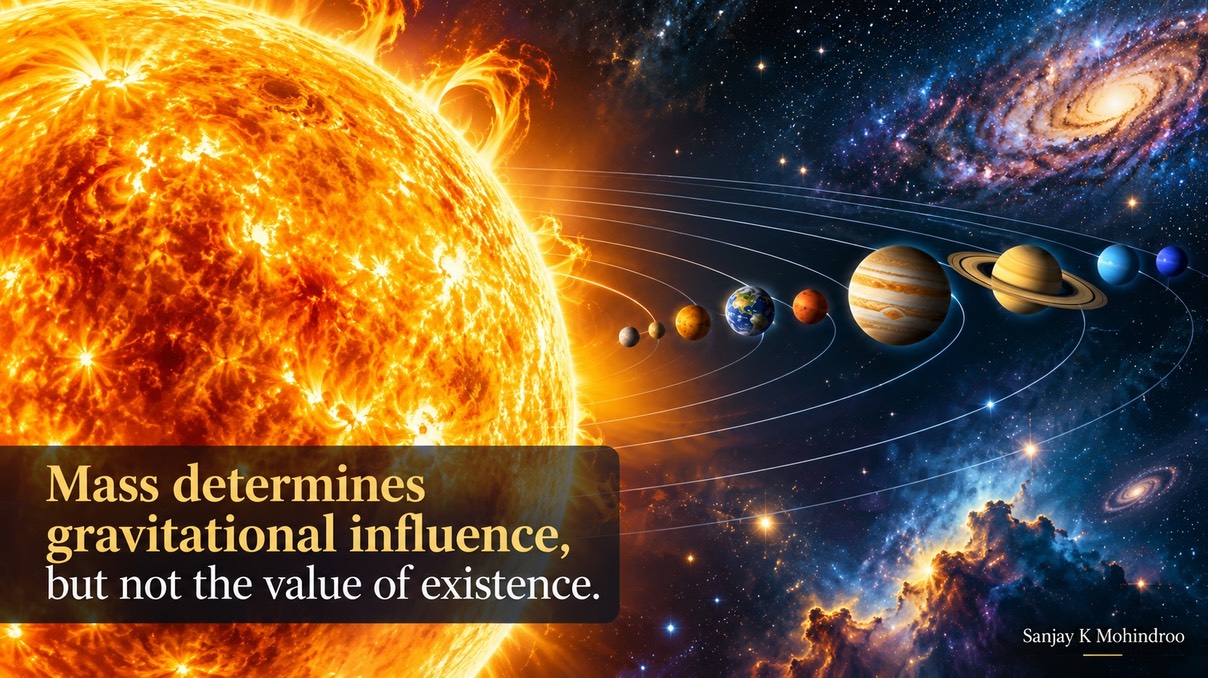
The Extraordinary Balance of Our Solar System
The Sun holds 99.86% of the solar system's mass, yet the remaining fraction contains planets, moons, oceans, and the extraordinary possibility of life.
Explore the Sun's mass, its 99.86% share of the solar system, and the gravity that shapes planetary motion and life on Earth.
A Cosmic Weighing Scale
An ordinary morning hides an extraordinary imbalance.
Every morning, sunlight enters our homes, warms the ground and marks the beginning of another day. We rarely consider the enormous object responsible for this familiar experience.
The Sun appears as a bright circle in the sky, seemingly no larger than the Moon. That apparent similarity is an illusion created by distance.
The Sun is roughly 400 times wider than the Moon, but it is also about 400 times farther from Earth. Their similar apparent sizes allow the remarkable spectacle of a total solar eclipse.
Yet even that comparison barely hints at the Sun's true dominance.
Imagine gathering every object in the solar system and placing them on an immense cosmic weighing scale. Eight planets, hundreds of moons, dwarf planets, asteroids, comets, and countless smaller objects would occupy one side.
The Sun alone would account for approximately 99.86% of the solar system's total mass.
Everything else combined would represent only about 0.14%.
That single fact offers a fascinating entry into #Astronomy and the physical forces shaping our celestial neighborhood.
The Giant That Outweighs Everything
An astonishing concentration of matter.
The Sun contains approximately 1.989 × 10³⁰ kilograms of matter.
That is nearly two thousand billion kilograms, an amount so enormous that ordinary numerical comparisons quickly lose their meaning.
A more intuitive comparison comes from Earth.
It would take approximately 333,000 Earth masses to equal the mass of the Sun.
Jupiter, the largest planet, provides another revealing comparison. Its mass exceeds the combined mass of all seven other planets. Yet the Sun is still approximately 1,048 times more massive than Jupiter.
Even the solar system's largest planet is a lightweight beside its central star.
This concentration of mass is not a coincidence.
Around 4.6 billion years ago, the solar system began forming from a collapsing cloud of gas and dust. Gravity pulled much of the material toward the center, creating the young Sun. The remaining material settled into a rotating disk, where dust grains collided, accumulated, and eventually formed planets and smaller bodies.
The result was an unequal distribution of matter that persists today.
The Sun inherited almost everything. The planets formed from what remained.
Gravity: The Architecture of Motion
One star provides the dominant gravitational influence.
Consider Earth travelling around the Sun at an average orbital speed of nearly 30 kilometres per second.
At that speed, Earth covers approximately 2.6 million kilometres every day.
Yet it does not simply fly away into interstellar space.
The Sun's gravity continuously bends Earth's motion into an orbit. Earth moves forward while gravitational attraction changes the direction of its velocity.
The same principle governs Mercury, Venus, Mars, and the outer planets.
This gravitational relationship gives the solar system its broad structure. Each planet follows its own orbit, influenced primarily by the Sun but also by gravitational interactions with other bodies.
Jupiter, for instance, influences asteroids, comets and neighboring planets. Its immense gravity can redirect smaller objects, sometimes sending them toward the inner solar system and sometimes scattering them away.
The Sun dominates the system, but the planets are not passive spectators.
Their interactions create a dynamic arrangement of motion, resonance, and occasional instability.
For #Astrophysics, the lesson is that gravitational dominance establishes the overall structure, while smaller influences contribute to its intricate behavior.
The Solar Furnace Behind Earth's Energy
Mass becomes the foundation of stellar power.
The Sun's importance extends far beyond gravity.
Deep within its core, enormous pressure and temperatures of roughly 15 million degrees Celsius allow hydrogen nuclei to fuse into helium.
During this process, a small amount of mass is converted into energy according to Einstein's famous relationship:
E = mc²
Every second, the Sun converts approximately 600 million tons of hydrogen into helium through fusion reactions. The resulting helium has slightly less mass than the original hydrogen, with the difference corresponding to approximately four million tons of mass converted into energy each second.
This energy gradually travels outward through the Sun before escaping into space as radiation.
A small fraction reaches Earth.
Sunlight powers photosynthesis, drives much of the climate system, and supplies energy that eventually moves through food chains.
The warmth of an afternoon, the growth of a forest and the movement of atmospheric winds are all connected, directly or indirectly, to energy originating in our star.
The Sun's immense mass creates the gravitational pressure necessary to sustain fusion in its core.
Its gravitational dominance and its role as an energy source are two expressions of the same extraordinary concentration of matter.
That relationship sits at the heart of #SpaceScience and stellar physics.
The Tiny Fraction That Became Our Home
Mass is not a measure of meaning.
Earth contributes only about three-millionths of the Sun's mass.
In terms of the entire solar system, our planet is almost negligible.
Yet this tiny fraction contains oceans, mountains, forests, cities and every recorded human experience.
There is something deeply moving about that contrast.
The most massive object in our solar system is a vast sphere of hot plasma. It has no solid surface, no oceans and no known life.
A much smaller planet, orbiting at a suitable distance and possessing a complex history of geological and chemical processes, supports an extraordinary diversity of living organisms.
This does not mean Earth's small size caused life to emerge. Habitability depends on many conditions, including liquid water, chemistry, atmospheric properties and long-term environmental stability.
It does remind us that physical scale and biological significance are very different measures.
A body can be tiny in mass and immense in meaning.
That perspective makes #PlanetaryScience more than an examination of distant objects. It becomes a way of appreciating the unusual conditions that make our own planet habitable.
Beyond Our Star: A Familiar Pattern Across the Galaxy
The solar system belongs to a much larger stellar story.
The Sun is not unique in dominating the mass of its planetary system.
Stars commonly form from collapsing regions of molecular clouds, while surrounding disks of gas and dust provide material for planets.
Astronomers have now identified thousands of planets orbiting other stars. These exoplanets vary enormously, from rocky bodies smaller than Earth to gas giants orbiting extremely close to their host stars.
Some planetary systems look very different from ours.
Others offer tantalizing similarities.
The Sun itself is a relatively ordinary main-sequence star, classified as a G-type star. Its mass is modest compared with the most massive stars, which can contain dozens or even more than a hundred times the Sun's mass.
This creates another remarkable shift in perspective.
The object that contains almost all the mass in our solar system is only one star among the hundreds of billions believed to populate the Milky Way.
Dominance, it seems, depends on the scale of observation.
The #Cosmos is full of such changes in perspective.
The Greatness of Small Things
The most meaningful part of a system need not be its largest.
The Sun has shone for approximately 4.6 billion years and is expected to continue its main-sequence life for roughly another five billion years.
Throughout that immense span, its gravity has provided the central influence shaping planetary orbits, while its radiation has supplied Earth with the energy necessary for much of life's activity.
Its mass is overwhelming. Its influence is undeniable.
Yet almost everything humanity has ever loved, created, questioned or imagined has taken place on a planet that contributes only a minute share of the solar system's matter.
That is perhaps the most beautiful perspective offered by #ScienceEducation.
The Sun teaches us that mass determines gravitational influence, but not the value of existence.
Sometimes the smallest part of an enormous system holds its most remarkable story.
#Astronomy #SpaceScience #SolarSystem #TheSun #Astrophysics #Cosmos #SpaceExploration #ScienceCommunication #Physics #STEM #ScienceEducation #PlanetaryScience
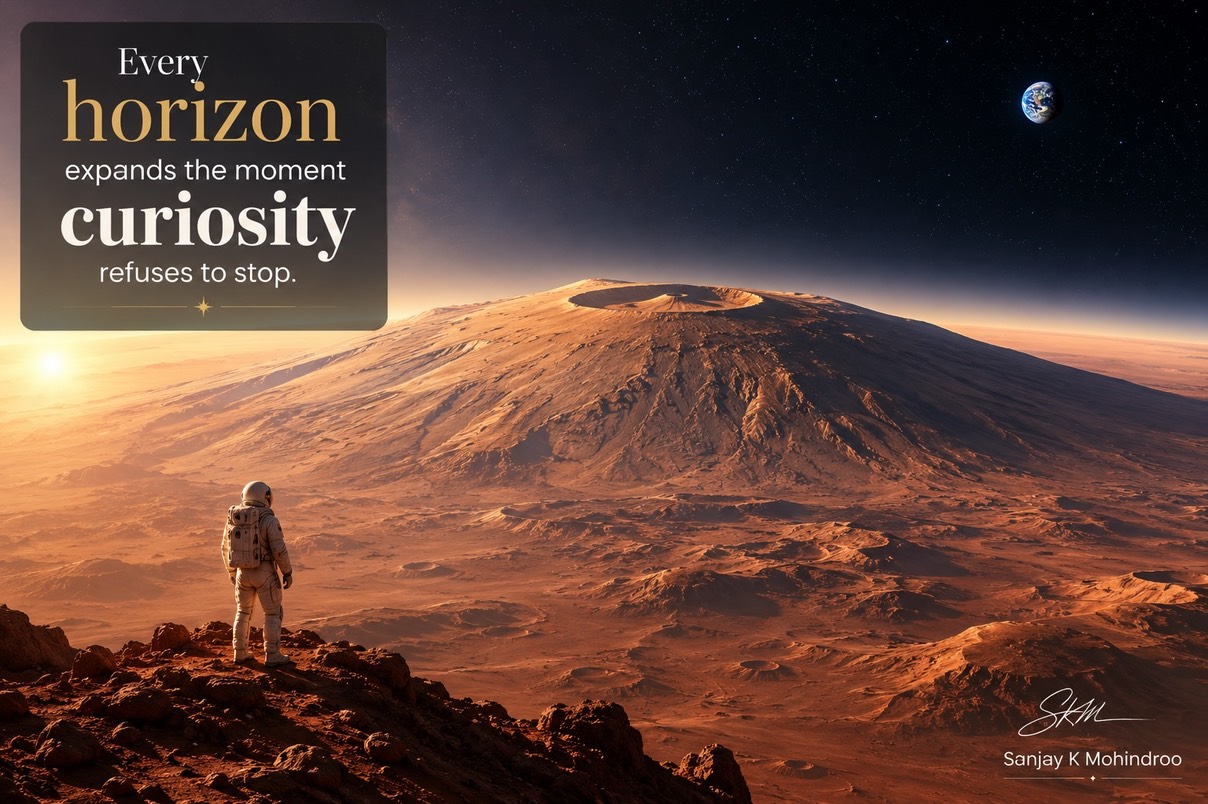
When a Mountain Outgrew a Planet's Horizon
Sanjay Mohindroo
The story of Olympus Mons is not only about the largest volcano in the solar system—it is also about patience, perspective, and the quiet power of time.
Olympus Mons, the largest volcano in the solar system, offers a remarkable glimpse into Mars' geological past and humanity's endless curiosity.
A Tiny Red Light with an Extraordinary Secret
Some of the greatest stories begin almost unnoticed
For thousands of years, people looked at Mars with curiosity. Ancient civilizations watched the reddish planet drift across the night sky and attached myths, gods, and legends to its mysterious glow. It was close enough to spark imagination, yet distant enough to remain silent.
No one could have imagined that beneath its dusty surface stood a mountain so immense that it would challenge every idea humanity held about planetary geology.
Today, we know that mountain as Olympus Mons.
Calling it a volcano hardly does it justice. It is a geological monument stretching nearly 600 kilometres across and rising around 22 kilometres above the surrounding Martian plains. Those numbers sound impressive on paper, yet they fail to capture the feeling they create. Olympus Mons is so large that standing at its base would reveal very little. The curvature of Mars itself would hide much of the mountain from view.
It is one of those rare places that forces us to think beyond everyday experience.
Science often changes our understanding through complicated equations or sophisticated technology. Sometimes, however, it changes us with something much simpler—a single fact that makes the universe feel far larger than it did yesterday.
Olympus Mons does exactly that.
Time Became the Greatest Architect
Every layer tells a story measured in millions of years
People often associate volcanoes with explosions, towering ash clouds, and rivers of molten rock rushing across the landscape. Earth has offered many dramatic reminders of volcanic power throughout history.
Mars chose a quieter approach.
Olympus Mons formed over an immense span of time through repeated lava flows that gently spread across the surface. Each eruption added another thin layer. Individually, those layers may have seemed insignificant. Together, they created the largest volcanic structure ever identified.
The image is surprisingly familiar.
Consider a library. One book contributes little to the appearance of the building. Add thousands of books over decades, and the shelves become a treasury of knowledge.
Think about an old city. A single generation builds homes. The next adds roads. Another plants trees. Another constructs schools and monuments. Centuries later, visitors admire the city without always noticing the countless small contributions that shaped it.
Olympus Mons reflects the same principle.
Its greatness was never built in a single dramatic moment.
The mountain reminds us that lasting achievements often grow quietly while attention is focused elsewhere.
That observation reaches far beyond astronomy. Whether someone is learning a new skill, conducting scientific research, building a business, or nurturing a community, meaningful progress usually comes from consistent effort rather than isolated moments of brilliance.
The volcano simply presents that truth on a planetary scale.
#PlanetaryScience quietly reminds us that time is often the greatest builder.
A Tale Written on Two Planets
Similar beginnings can lead to remarkably different endings
Earth and Mars were born from the same early solar system, yet their geological journeys gradually separated.
Both planets experienced volcanic activity.
Both developed mountains.
Both witnessed enormous internal forces reshaping their surfaces.
Yet one crucial difference altered everything that followed.
Earth's crust is divided into moving tectonic plates. These plates slowly shift over millions of years, carrying continents and volcanic systems with them. When magma rises from deep beneath the surface, the moving crust gradually transports the volcano away from its heat source. New volcanoes eventually appear elsewhere.
Mars does not share that characteristic.
Its crust remained comparatively stable. The volcanic hotspot beneath Olympus Mons continued feeding lava into the same location for an extraordinarily long period.
Imagine placing a bucket beneath a dripping tap.
Move the bucket every few minutes, and no single location collects very much water.
Leave the bucket untouched for years, and the result becomes dramatically different.
That simple contrast helps explain one of the greatest geological mysteries in our solar system.
The lesson extends beyond science.
Large outcomes often emerge from small differences in underlying systems.
Whether examining economies, organisations, ecosystems, or cultures, the surrounding conditions quietly influence the final result.
Success is rarely shaped by effort alone. The environment matters just as much.
A Mountain Too Large to Understand at First Glance
Numbers become meaningful only through comparison
Human beings naturally understand the world through familiar reference points.
Olympus Mons becomes easier to appreciate when viewed alongside places we already know.
Mount Everest rises approximately 8.8 kilometres above sea level.
Olympus Mons towers to almost three times that height.
Yet height tells only part of the story.
The volcano spans roughly the distance between major metropolitan regions that many people would consider separate journeys. If placed on Earth, it would dominate an area larger than many countries.
Its summit features an enormous caldera stretching nearly 80 kilometres across—a reminder that even the summit of this giant experienced repeated volcanic collapse and renewal.
Curiously, despite its incredible height, many of its slopes remain relatively gentle.
A person standing on Olympus Mons might not experience the dramatic cliffs often associated with towering mountains. Instead, the climb would feel gradual, almost subtle.
Perspective changes everything.
Some realities become harder—not easier—to recognise as they grow larger.
Large organisations can overlook small inefficiencies.
Long-term environmental changes often escape daily attention.
Personal growth becomes visible only after years have passed.
Olympus Mons offers another example of this quiet paradox.
Its immense size hides itself through gradual change.
#Mars encourages us to remember that scale often disguises itself.
Machines Crossed the Distance Before Humans Could
Curiosity travelled farther than footsteps
Every meaningful observation of Olympus Mons has come through machines built by human imagination.
Long before detailed satellite imagery existed, astronomers relied on telescopes that revealed only faint surface markings on Mars. They suspected volcanic regions, but certainty remained beyond reach.
The arrival of spacecraft transformed everything.
Orbiters equipped with high-resolution cameras, radar systems, spectrometers, and laser altimeters gradually assembled an increasingly detailed portrait of the Martian surface.
Each mission improved the picture.
Each technological breakthrough replaced assumptions with evidence.
Images revealed lava channels stretching across vast plains.
Elevation maps showed the volcano rising above surrounding terrain with astonishing clarity.
Researchers began reconstructing the geological history hidden within every ridge, lava flow, and crater.
Technology often receives attention for convenience or speed.
Its deeper value lies elsewhere.
It expands the range of questions humanity can meaningfully ask.
Every telescope extends our vision.
Every spacecraft extends our reach.
Every mission reminds us that curiosity is not limited by physical distance.
#SpaceExploration has always been about extending human perspective rather than simply travelling farther.
Silent Clues Hidden in Ancient Stone
Every volcanic layer preserves a chapter from a planet that looked very different long ago
When scientists study Olympus Mons, they are not simply measuring the height of a mountain. They are reading one of the oldest geological records available in our solar system.
Unlike Earth, Mars has experienced relatively little geological recycling. Our planet constantly reshapes itself through earthquakes, erosion, plate movement, rainfall, oceans, and vegetation. Mountains rise and wear away. Rivers carve valleys. Continents drift. Landscapes continually rewrite their own history.
Mars has lived a quieter existence.
Its dry environment and inactive tectonic system preserved features that would likely have disappeared long ago on Earth. Lava flows that formed millions—even billions—of years ago remain visible today, allowing researchers to reconstruct events from a remarkably distant past.
Olympus Mons therefore becomes far more than an isolated volcano.
It serves as an archive.
Every ridge, every lava plain, and every collapsed crater offers clues about the temperature inside ancient Mars, the movement of magma beneath its crust, and the conditions that once shaped the planet's surface.
Science often resembles detective work more than dramatic revelation. Researchers collect small pieces of evidence, compare observations, challenge assumptions, and slowly assemble a story that no single clue could tell alone.
Olympus Mons reminds us that even silent landscapes have stories waiting to be read.
#Geology continues to reveal histories that no written record could preserve.
Imagination Walked Across Mars Before Humans Could
Every great journey begins long before the first footsteps
No human has climbed Olympus Mons.
No explorer has stood inside its enormous caldera.
Yet millions of people have already travelled there through imagination.
Computer simulations, orbital photography, digital terrain models, and scientific visualisations allow us to picture landscapes that remain physically beyond our reach. Students study Martian volcanoes in classrooms. Engineers design future habitats. Artists paint scenes inspired by data collected millions of kilometres away.
Knowledge has always travelled faster than people.
Centuries before aircraft existed, maps inspired exploration.
Long before submarines reached the deepest oceans, scientists imagined what might lie beneath.
The same pattern continues with Mars.
Every new image fuels fresh questions.
Every mission encourages another generation to study engineering, astronomy, geology, robotics, or planetary science.
The value of exploration cannot be measured only by the places we reach.
It can also be measured by the people it inspires along the way.
A child fascinated by Olympus Mons today may become the scientist who designs tomorrow's Mars mission.
Curiosity has always created futures that previous generations could not predict.
Perspective Changes Along with Distance
Looking outward often teaches us something closer to home
It is tempting to view Olympus Mons simply as a scientific curiosity—an impressive statistic tucked inside a textbook or documentary.
Its deeper value lies elsewhere.
The volcano quietly reshapes perspective.
Standing beneath Earth's mountains often reminds us of our own smallness. Looking at Olympus Mons extends that feeling even further. It reminds us that the limits we casually assume are often temporary.
History offers many examples.
People once believed mountains higher than Everest could not exist.
There was a time when no one imagined oceans beneath the icy shells of distant moons.
There was also a time when planets beyond our solar system remained purely speculative.
Observation changed every one of those assumptions.
The lesson reaches beyond astronomy.
Every field of human progress carries moments when accepted limits quietly disappear.
Medicine advances because researchers question existing knowledge.
Engineering advances because designers imagine structures that once seemed impossible.
Education advances because each generation builds upon the work of the last.
Olympus Mons belongs within that larger story.
It reminds us that certainty should never become the enemy of curiosity.
#ScienceCommunication succeeds not only by sharing answers but also by encouraging better questions.
Tomorrow's Explorers Already Study Yesterday's Volcano
Every mission prepares the next chapter rather than closing the last
Mars remains one of humanity's most ambitious scientific destinations.
Orbiters continue mapping its surface with increasing precision.
Rovers analyse ancient rocks in search of clues about water, climate, and habitability.
Future missions may eventually return Martian samples to Earth, allowing laboratories to examine materials with a level of detail impossible through robotic instruments alone.
Many space agencies and private organisations also continue exploring the possibility of sending astronauts to Mars during the coming decades.
If that day arrives, Olympus Mons will undoubtedly remain one of the most fascinating landmarks awaiting exploration.
Researchers may examine lava deposits directly.
They may investigate volcanic minerals hidden beneath layers of dust.
They may compare orbital observations with physical measurements collected on site.
Yet even if humans eventually stand upon its slopes, the mountain's greatest contribution will remain unchanged.
It has already transformed our understanding of planetary geology.
It has already expanded humanity's sense of scale.
It has already inspired countless conversations about exploration, science, and our place in the universe.
Some discoveries change maps.
Others change minds.
Olympus Mons has done both.
Beyond the Summit Lies a Bigger Story
Wonder grows strongest when curiosity remains alive
When people hear that Olympus Mons is the largest volcano in the solar system, the fact is impressive.
When they understand the story behind that fact, it becomes meaningful.
A stable crust allowed lava to accumulate over millions of years.
Patient geological processes created a mountain too large for the human eye to fully appreciate from its own base.
Advanced spacecraft carried our curiosity across millions of kilometres and transformed distant landscapes into places we can study with remarkable detail.
None of these ideas stand alone.
Together they reveal something much larger.
Human progress has always depended upon the willingness to ask questions that appear impossible at first.
Every telescope pointed toward the sky, every spacecraft launched into space, and every scientific mission begins with the same quiet belief—that there is still more to learn.
Olympus Mons stands as a monument to that belief.
It reminds us that nature continues to exceed imagination, not because it seeks to amaze us, but because the universe has always been richer than our earliest understanding.
Perhaps that is the mountain's greatest legacy.
It does not simply tower above every volcano we know.
It quietly invites every generation to raise its own horizon.
As we continue studying Mars, we are also studying ourselves—our curiosity, our persistence, and our ability to transform distant mysteries into shared knowledge. The greatest summit may never be the peak of Olympus Mons itself. It may be the moment humanity realises that every answer opens the door to another question, and that the pursuit of understanding is one journey with no final destination.
Throughout that journey, conversations sparked by #MarsScience, #SpaceExploration, and #ScienceCommunication continue connecting researchers, educators, students, and curious minds across the globe. Each shared observation keeps the spirit of exploration alive.
#Mars #OlympusMons #MarsScience #PlanetaryScience #Astronomy #SpaceExploration #STEM #ScienceCommunication #SpaceResearch #SolarSystem #Innovation #Curiosity #Geology #SpaceEducation #Science