

Did You Know
The Planet That Could Float: A Cosmic Fact That Changes the Way We See Size

Sanjay Mohindroo
One extraordinary scientific fact reveals that the universe often rewards curiosity more than assumption.
Saturn would float in water because its average density is lower than water. Explore the science and the perspective behind this remarkable fact.
A Moment That Stops Every Conversation
One sentence that sounds impossible
Some facts have a way of stopping a conversation in its tracks.
Imagine telling someone that Saturn—the second-largest planet in our solar system—would float in water if a container large enough existed. Most people instinctively reject the idea. They picture an enormous planet wrapped in brilliant rings, powerful enough to influence dozens of moons. Floating seems like the last thing such a giant should do.
Yet that statement is scientifically accurate.
The beauty of this fact is not that it tricks us. It reminds us that intuition is often built on everyday experience, while nature follows rules that are sometimes wonderfully surprising. That small moment of disbelief is the beginning of curiosity, and curiosity has always been one of humanity's greatest strengths. #ScienceFacts #Curiosity
A Number That Tells a Different Story
Mass alone never completes the picture
Our minds naturally connect size with heaviness.
A mountain feels heavier than a rock. A truck outweighs a bicycle. These comparisons work because our daily experiences rarely require us to think about density.
Density simply measures how much matter occupies a given volume. Two objects can be similar in size yet contain very different amounts of material. A steel cube and a wooden cube may look identical, but one sinks while the other floats because their densities are different.
Saturn follows the same principle on a spectacular scale.
The planet is composed mostly of hydrogen and helium, elements that are remarkably light. Even though Saturn contains more than ninety-five times Earth's mass, it spreads that material across an enormous volume. Its average density is approximately 0.69 grams per cubic centimetre, comfortably below water's density of about 1 gram per cubic centimetre.
If someone could somehow create an unimaginably large ocean and an equally impossible container, Saturn's average density suggests that it would float.
The experiment will never happen. The idea survives because it transforms a scientific measurement into an unforgettable mental picture. #Astronomy #Physics
A Planet Built Unlike Any Other
Layers that challenge familiar expectations
Thinking of Saturn as a solid object can be misleading.
Unlike Earth, Saturn has no solid surface on which someone could stand. Its outer regions consist largely of clouds and gases, gradually giving way to denser fluids under crushing pressure. Deeper inside, temperatures rise dramatically and pressure becomes almost unimaginable.
Its famous rings, although visually magnificent, contribute very little to the planet's overall mass. They are made mostly of countless pieces of ice and rock orbiting together in astonishing harmony.
This combination of immense size, light elements and unusual internal structure gives Saturn characteristics unlike almost anything we experience on Earth.
The more closely scientists study the planet, the more it reminds us that nature rarely fits neatly into familiar categories. #SpaceScience
A Classroom Hidden in the Solar System
Simple comparisons create lasting understanding
Science often becomes memorable when complex ideas are connected to familiar experiences.
Many people struggle to remember numerical values such as density measurements or planetary composition. Yet almost everyone remembers the image of Saturn floating in an enormous ocean.
Teachers have relied on thought experiments for generations because imagination makes abstract concepts easier to understand. Albert Einstein frequently used imagined situations to explore physics long before equations confirmed his ideas.
Saturn's floating story works in much the same way. It gives people a picture they can carry with them, even if the actual experiment remains impossible.
Great science communication is not about making science simpler. It is about making ideas easier to picture without losing their accuracy. #ScienceCommunication #Education
A Quiet Lesson Beyond Astronomy
Appearances often tell only part of the story
The appeal of Saturn's floating secret extends beyond astronomy.
Daily life encourages quick judgments. We assess people within moments of meeting them. Organisations are judged by their size. Ideas are often accepted or dismissed based on appearances rather than substance.
Saturn quietly reminds us that surface impressions rarely reveal the full picture.
A planet that appears overwhelmingly massive carries an average density lower than water. Something that seems impossible becomes perfectly logical once we understand the hidden details.
The same pattern appears in many parts of life. Calm individuals sometimes carry extraordinary determination. Small teams create remarkable innovations. Quiet ideas gradually reshape industries.
Looking beneath appearances often changes the entire conversation.
That habit of looking deeper is one of science's greatest gifts.
#CriticalThinking #Learning
A Sky That Rewards Curiosity
Wonder grows with every unexpected fact
Every generation inherits a slightly clearer view of the universe.
Powerful telescopes reveal new moons, hidden storms and distant galaxies. Spacecraft return photographs that once belonged only to imagination. Yet the most valuable discoveries are often the ones that change the way people think rather than simply adding another statistic.
Saturn floating in water belongs to that rare group of ideas.
It encourages children to ask another question. It reminds adults that learning never really ends. It demonstrates that scientific literacy is less about memorising facts and more about developing the habit of curiosity.
Every surprising fact becomes an invitation to look upward with fresh eyes.
#STEM #LifelongLearning
A Lasting Reflection
Wonder begins with a willingness to question assumptions
No ocean could ever hold Saturn, and no container could ever be built on such a scale. Yet the image continues to inspire because it transforms an invisible scientific property into something anyone can imagine.
The universe is filled with moments like this—moments that gently remind us that appearances can mislead, assumptions deserve testing and curiosity remains one of our greatest companions.
Perhaps the most valuable lesson is not that Saturn would float.
It is that every remarkable answer begins with someone willing to ask a surprising question.
#ScienceFacts #Astronomy #Space #SpaceScience #Physics #STEM #ScienceCommunication #Education #Curiosity #CriticalThinking #LifelongLearning
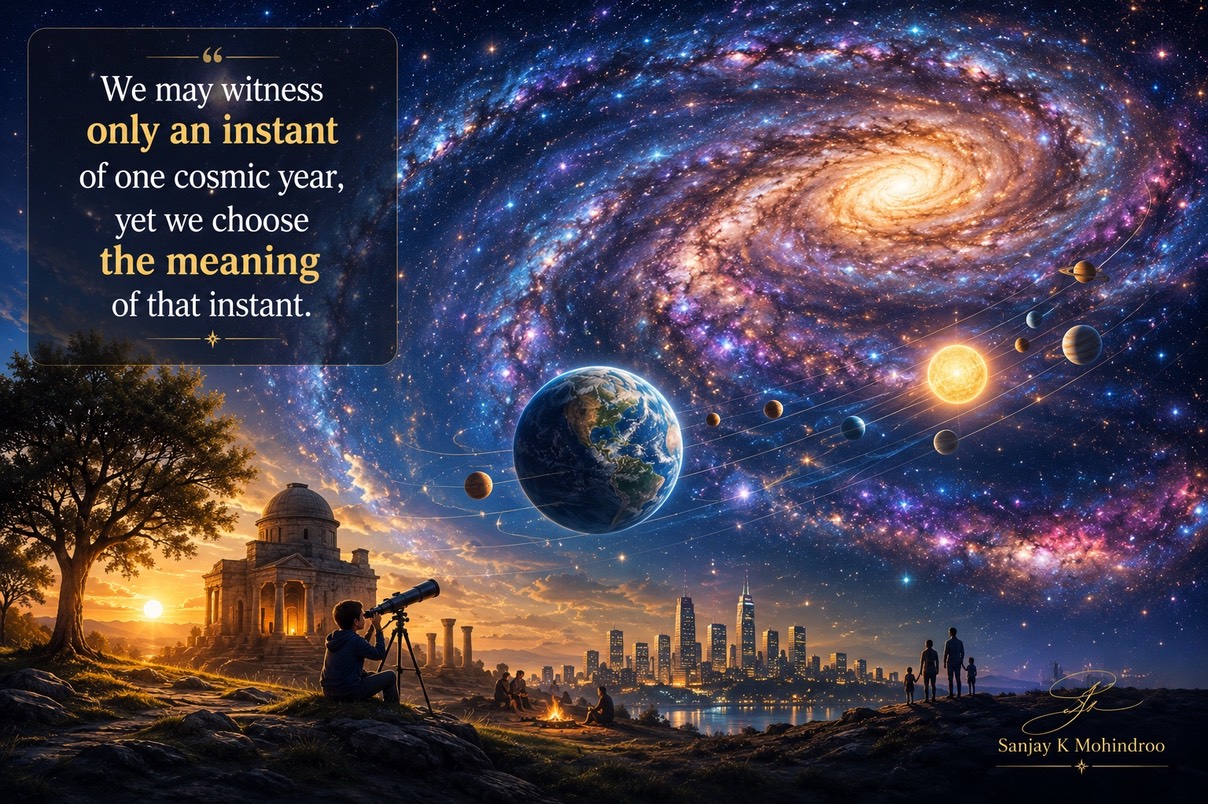
One Orbit, Countless Generations
Sanjay Mohindroo
The Milky Way Keeps Moving Even When We Believe Life Is Standing Still
The solar system takes 230 million years to orbit the Milky Way, offering a powerful perspective on time, humanity, and our place in space.
An Ordinary Day Beneath an Extraordinary Sky
Every routine hides a remarkable journey
A typical day begins with familiar rituals. An alarm sounds. Coffee brews. Roads fill with commuters. Students rush to class. Businesses open their doors. Life feels comfortably predictable.
Nothing about that morning suggests movement on an unimaginable scale.
Yet while we answer emails, celebrate birthdays, or make plans for the weekend, the entire solar system is travelling through the Milky Way at incredible speed. Earth is not sitting quietly in space. It is orbiting the Sun, while the Sun carries every planet around the centre of our galaxy.
That galactic journey takes roughly 230 million years to complete.
Astronomers call this a cosmic year.
It is a number so immense that the human mind struggles to grasp it. Still, once that timescale settles into our imagination, something quietly changes. We begin looking at our own lives a little differently.
The Universe Keeps an Older Calendar
A clock measured in millions of years
Imagine opening a history book that begins not with the first civilisation, but with the formation of Earth.
Now imagine compressing every recorded chapter of human history into the final few seconds before midnight.
Against a cosmic year, humanity has barely arrived.
The last time our solar system occupied its current position in the Milky Way, dinosaurs roamed forests that no longer exist. The Himalayas had not reached their present height. Continents were arranged differently. Mammals remained small, and no human had ever looked up at the stars with curiosity.
Since then, entire ecosystems have appeared and disappeared.
Species have risen and vanished.
Civilisations have flourished, faded, and left only fragments behind.
Yet throughout all of it, the Milky Way has continued its quiet rotation.
That thought does not diminish our importance. It simply reminds us that the universe measures time with remarkable patience.
Every Lifetime Becomes More Precious
A brief moment filled with lasting meaning
People often hear astronomical numbers and assume they make human existence feel insignificant.
The opposite tends to happen.
Recognising that we experience only a tiny fraction of one cosmic year gives greater value to every conversation, every friendship, and every opportunity to create something meaningful.
A lifetime may seem brief against hundreds of millions of years, yet meaning has never depended on duration.
A teacher may influence generations through one lesson.
A scientist may spend decades studying a single question that changes medicine forever.
An artist may create work that continues speaking to people centuries later.
Their contributions occupy only a brief instant on the universe's timeline, but their impact stretches far beyond their own lives.
Time measures existence.
Purpose measures significance.
Perspective Changes Everyday Decisions
Small worries begin finding their proper place
Modern life encourages urgency.
Notifications demand immediate attention.
Deadlines seem overwhelming.
Minor inconveniences often feel larger than they truly are.
Looking at the Milky Way does not erase those responsibilities, but it gently rearranges their importance.
The email that caused stress this morning will probably be forgotten next month.
The meeting that seemed critical may never be remembered next year.
The difficult season that feels endless today may become a story that shapes someone's wisdom tomorrow.
Astronomy offers more than scientific facts.
It quietly teaches emotional perspective.
Standing beneath a clear night sky reminds us that our challenges exist within something far larger, while also reminding us that our choices still matter deeply.
Those two ideas comfortably coexist.
Curiosity Connects Every Generation
Questions that never grow old
Thousands of years ago, people looked toward the same stars without telescopes, satellites, or spacecraft.
They wondered about the lights scattered across the darkness.
Those questions never disappeared.
Instead, they inspired mathematics, navigation, philosophy, engineering, physics, and astronomy.
Eventually, curiosity carried humanity beyond Earth itself.
Today, observatories map distant galaxies, robotic spacecraft explore neighbouring planets, and powerful telescopes capture light that has travelled for billions of years before reaching us.
Every new answer produces another question.
That endless cycle may be humanity's greatest strength.
Curiosity builds bridges between generations.
One child looking through a telescope today may become the scientist who answers tomorrow's biggest mystery.
The Milky Way Offers Quiet Optimism
Movement without hurry
Nature rarely rushes.
Trees require decades to mature.
Coral reefs develop over centuries.
Mountains rise over millions of years.
Galaxies continue their graceful motion across unimaginable spans of time.
The Milky Way reminds us that meaningful progress often happens gradually.
Growth rarely announces itself in dramatic moments.
It appears through consistent effort, thoughtful choices, and patience.
That lesson applies just as comfortably to personal development as it does to scientific exploration.
The universe has never hurried its own story.
Perhaps we do not always need to hurry ours.
One Orbit Shared by Every Generation
A reminder carried through the stars
Long after today's headlines have faded, the solar system will continue its steady journey around the centre of the Milky Way.
Every generation will occupy only a tiny fraction of that orbit.
Yet within those brief moments, people will continue falling in love, raising families, writing books, solving problems, building communities, asking questions, and reaching toward the stars.
That may be the most beautiful part of our existence.
We are temporary travellers aboard an ancient journey, yet we possess the remarkable ability to fill our short stretch of that voyage with kindness, imagination, curiosity, and purpose.
The Milky Way will never remember our names.
People might.
And perhaps that is enough.
Throughout this shared journey, #Astronomy, #MilkyWay, #SolarSystem, and #SpaceScience continue reminding us that perspective is one of the greatest gifts science offers. Every new observation fuels #Curiosity, strengthens #STEM, encourages #ScienceCommunication, and inspires #Learning, helping us appreciate both the vast universe and the meaningful lives we build within it.
The Planet That Refused to Follow the Crowd
Sanjay Mohindroo
One quiet neighbour in our Solar System offers a timeless reminder that nature never depends on perfect symmetry.
Venus rotates in the opposite direction, revealing fresh insight into planetary motion and scientific curiosity.
An Evening Star with an Unexpected Story
A familiar light in the sky carries one of astronomy's most fascinating mysteries.
Almost everyone has admired Venus without realising it. Often called the Morning Star or Evening Star, it shines so brightly that it catches attention even before darkness settles. At first glance, it seems like another beautiful object drifting through space.
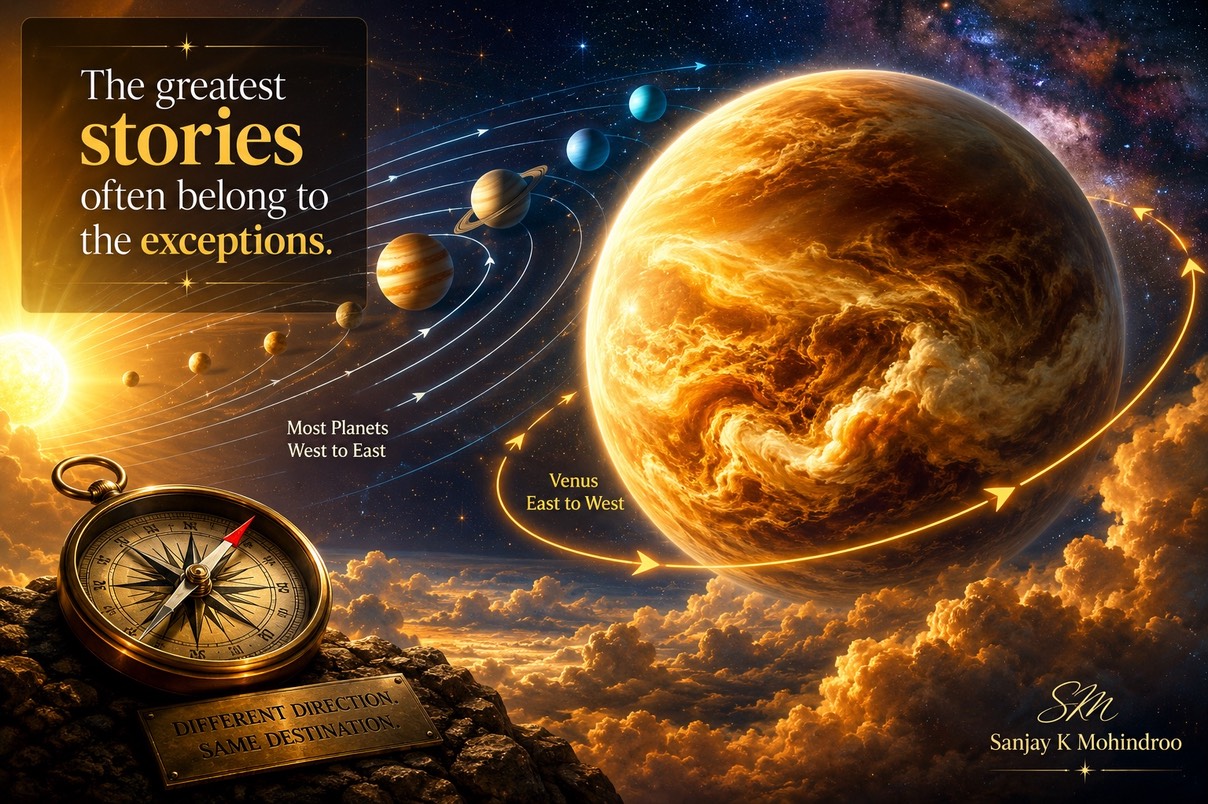
Yet beneath those thick golden clouds lies one of the Solar System's greatest surprises. Venus rotates in the opposite direction to nearly every other planet.
That single fact transforms an ordinary observation into an invitation to look closer.
#Astronomy #Space
Patterns That Leave Room for Exceptions
The universe rewards curiosity more than assumptions.
Children often learn that planets formed from the same spinning cloud of gas and dust. Since that cloud rotated in one direction, it seems natural that most planets would spin the same way.
They mostly do.
Mercury, Earth, Mars, Jupiter, Saturn, Uranus and Neptune all rotate from west to east, although Uranus rolls on its side because of an ancient collision.
Venus quietly breaks the pattern.
Its day is longer than its year. A complete rotation takes about 243 Earth days, while one trip around the Sun takes roughly 225 Earth days. If someone could stand safely on its surface, the Sun would appear to rise in the west and set in the east.
One planet turns an accepted rule into a fascinating conversation.
Ancient Collisions and Gentle Forces
Several possibilities continue to shape scientific thinking.
Astronomers have debated Venus's unusual rotation for decades.
One explanation suggests that a massive collision early in its history reversed its spin. During the formation of the Solar System, giant impacts were common. Powerful encounters reshaped entire planetary surfaces.
Another explanation paints a slower picture. Venus possesses an extraordinarily dense atmosphere. Powerful winds circle the planet at remarkable speeds. Over immense stretches of time, those atmospheric forces may have interacted with the planet's rotation, gradually slowing it before reversing its direction.
Neither explanation has settled the debate completely.
Science often grows stronger by accepting uncertainty instead of rushing toward certainty.
#PlanetaryScience #Science
Quiet Confidence Across the Sky
The brightest objects rarely explain themselves.
Venus never announces that it spins differently. It simply continues its journey.
People often work in much the same way. Many successful thinkers, artists, and scientists followed paths that appeared unusual at first. Their value became visible only after patience replaced first impressions.
Nature offers similar reminders everywhere.
The tallest mountains began beneath oceans—diamonds formed under crushing pressure. Birds transformed from ancient dinosaurs over millions of years.
Difference is not an interruption to nature.
Difference is part of nature.
#Learning #Perspective
Curiosity Beyond the Telescope
Small observations often lead to lasting understanding.
Astronomy has always encouraged humility.
Every generation believes it understands the universe a little better. Then another observation appears and gently expands that understanding.
Venus reminds us that knowledge is rarely complete. Each answer opens another thoughtful question. That continual search has driven scientific progress for centuries and continues today through space missions, telescopes and planetary research.
The greatest reward is not finding every answer.
It is continuing to ask better questions.
#Curiosity #STEM
A Sky Filled with Gentle Reminders
One unusual planet continues to inspire thoughtful observation.
Venus could easily have been remembered only as Earth's brilliant neighbour.
Instead, it became a lasting reminder that nature rarely fits perfectly into simple expectations.
Its backward rotation encourages scientists to keep investigating, students to remain curious and all of us to recognise that exceptions often make the strongest stories.
The next time Venus appears low on the horizon, it will look peaceful and familiar.
Yet hidden beneath those glowing clouds is a quiet lesson.
Moving differently does not diminish significance. Sometimes it becomes the very reason something is remembered.
#Astronomy #Science #Venus #Space #PlanetaryScience #STEM #Curiosity #Innovation #SpaceExploration #Learning #Perspective #SolarSystem
Ancient Strength Hidden in Plain Sight.

Sanjay Mohindroo
The dinosaur plant survives extreme dehydration and springs back to life, offering a lesson in patience and endurance.
At first glance, it looks dead.
Its leaves curl inward. Its color fades. It becomes a dry, brittle ball that seems beyond saving. Most people would toss it away without a second thought.
Then something remarkable happens.
A little water touches the plant, and within hours it begins to change. Green returns. Leaves open. Life appears again.
This is the dinosaur plant, one of nature's most striking examples of survival.
A Living Relic
A Plant That Refuses to Quit
The dinosaur plant, often called the resurrection plant, has survived for millions of years. Long before modern cities, roads, or farms existed, its ancestors were already adapting to harsh conditions.
In dry regions, rain can disappear for months. Many plants cannot endure such long gaps without water. The dinosaur plant takes a different path.
When drought arrives, it enters a dormant state. Growth stops. Energy use drops. The plant curls into a tight shape and waits.
It is not fighting nature. It is working with it.
That simple shift has helped it survive across countless seasons.
A Return That Feels Like Magic
Life Hidden Beneath the Dry Surface
Imagine finding a brown, lifeless plant on a shelf.
You place it in water with little expectation. Then, over the next day, the leaves slowly spread outward. Green shades begin to appear. The plant seems to wake from a long sleep.
The first time people witness this change, many assume it is a trick.
Yet the process is real.
The dinosaur plant can withstand extreme dehydration by protecting its cells during dry periods. When water returns, those cells regain function and normal growth resumes.
The transformation feels dramatic because most living things cannot recover after losing so much moisture.
The dinosaur plant can.
Quiet Lessons from Harsh Conditions
Strength Without Force
Modern life often rewards constant motion.
People push through long workdays, packed schedules, and endless demands. Rest is sometimes viewed as weakness.
The dinosaur plant tells a different story.
During drought, it does not waste energy trying to grow. It pauses. It conserves. It waits for better conditions.
There is wisdom in that approach.
Strength is not always about moving forward at full speed. Sometimes it means protecting your resources until the right moment arrives.
Nature repeats this lesson often, but few examples are as clear as this one.
#Nature #Plants #Growth
A Symbol That Still Matters
Hope Rooted in Reality
Scientists study the dinosaur plant for insights into drought tolerance and plant survival. Its unique traits may help future research as climates become less predictable.
Yet its appeal goes beyond science.
People are drawn to stories of recovery. They admire signs of life returning after hardship. The dinosaur plant offers a real example of both.
It reminds us that appearances can be misleading. A period of stillness does not always mean the end.
Sometimes it is simply preparation for a new beginning.
That message feels as relevant today as it did centuries ago.
The dinosaur plant survives conditions that seem impossible.
It dries out, waits patiently, and returns when water arrives. Its story is not about speed or power. It is about endurance, timing, and quiet strength.
In a culture that often celebrates constant activity, this ancient plant offers a different perspective.
Sometimes survival is not about pushing harder.
Sometimes survival is about knowing when to pause, protect what matters, and be ready when the moment comes.
The dinosaur plant has been teaching that lesson for millions of years.
#DinosaurPlant #ResurrectionPlant #Nature #PlantLife #DroughtTolerance #AncientPlants #NatureLovers #Botany #Growth #Inspiration
Point Nemo: The Loneliest Place That Says the Most About Us.

Sanjay Mohindroo
Point Nemo is the most remote place on Earth, yet its silent waters reveal a powerful story about curiosity, science, and human perspective.
Every map has a place that feels almost unreal.
For Earth, that place is Point Nemo. It sits deep in the South Pacific Ocean, farther from land than any other spot on the planet. No city lights reach it. No ships pass by each day. Even the nearest people are often astronauts flying overhead.
That sounds like the start of a science fiction story. Yet Point Nemo is very real. Its silence tells a story that stretches far beyond the sea.
A Dot Surrounded by Endless Blue
Distance Becomes the Main Character
Imagine standing on a beach and looking at the sea.
Now imagine sailing for days without seeing another shore. Then keep going. That is the feeling Point Nemo creates. It lies almost 2,700 kilometers from the nearest islands, making it the most isolated place on Earth.
The ocean around it feels endless. Waves rise and fall without crowds, ports, or fishing boats. The sky meets the water in every direction. Nothing breaks the line between them.
This is not a place people visit for fun. It exists because geography allows it. Nature quietly drew a circle of empty water and placed Point Nemo at its center.
That simple fact has turned a lonely point into one of Earth's most fascinating locations.
Silence That Serves a Purpose
Space Finds a Quiet Home
Most people think of the ocean as a place full of life.
Point Nemo tells a different story. Very little marine life lives near its center because nutrients remain scarce. The same isolation that keeps people away also limits many sea creatures.
Yet this quiet place serves a rare purpose.
When old satellites and spacecraft finish their missions, many are guided toward these waters. Engineers call the region the spacecraft cemetery because retired spacecraft safely fall into the ocean here.
There is something poetic about that image.
Machines built to explore the stars complete their final journey in the loneliest part of Earth's oceans. Their story begins with human dreams and ends in peaceful silence.
#Space #Science
A View That Changes Perspective
Distance Makes Small Things Smaller
Stories often change when someone steps back.
Point Nemo offers that same lesson.
Life often feels crowded with meetings, deadlines, messages, and endless noise. Every task demands attention. Every problem feels urgent.
Then you picture a single point floating in an ocean larger than many countries combined.
Suddenly, everyday worries seem smaller.
This is not about ignoring problems. It is about seeing them from a wider view. Perspective has always been one of humanity's greatest tools. Point Nemo reminds us that distance can bring clarity.
Sometimes the best answer comes after stepping back rather than pushing harder.
Curiosity Keeps the Map Alive
Empty Places Still Matter
Many people ask whether every corner of Earth has already been explored.
Point Nemo quietly answers that question.
Satellites can measure it. Scientists can study it. Ships can reach it. Yet it still feels mysterious because very few people ever experience it.
Its value does not come from buildings or business. It comes from curiosity.
Humans have always looked beyond the next hill, across the next sea, and into the next sky. That habit built cities, crossed oceans, and reached the Moon.
Point Nemo belongs to that same story.
It reminds us that exploration is not always about finding treasure. Sometimes it is about proving that wonder still exists.
#Exploration #Knowledge
A Meeting Place Between Earth and Space
One Story Connects Two Frontiers
Few places connect oceans and space as naturally as Point Nemo.
Below lies one of Earth's most remote stretches of water. Above, satellites circle the planet every day. Between those two spaces sits a quiet reminder of human progress.
People built machines that left Earth.
People also planned safe ways to bring them home.
That balance speaks well of us. Progress carries responsibility. Every mission begins with ambition and ends with careful planning.
Point Nemo rarely appears in headlines. Still, it plays a silent role in one of humanity's greatest achievements.
Sometimes the most important places work without asking for attention.
Every Empty Place Holds a Story
Silence Leaves Room for Thought
Point Nemo will never become a busy tourist stop.
It does not need famous landmarks or bright lights. Its power comes from something much simpler.
It gives us space to think.
The ocean around it reminds us that Earth remains vast. Human curiosity remains even larger. Every map still holds places that inspire questions instead of answers.
That may be the greatest gift of all.
A lonely point in the Pacific reminds billions of people that wonder has not disappeared. It only waits patiently for someone willing to look a little farther.
#PointNemo #Science #Space #Geography #Ocean #Exploration #Earth #Curiosity #Spacecraft #Knowledge