
Sanjay Mohindroo
The Milky Way Keeps Moving Even When We Believe Life Is Standing Still
The solar system takes 230 million years to orbit the Milky Way, offering a powerful perspective on time, humanity, and our place in space.
An Ordinary Day Beneath an Extraordinary Sky
Every routine hides a remarkable journey
A typical day begins with familiar rituals. An alarm sounds. Coffee brews. Roads fill with commuters. Students rush to class. Businesses open their doors. Life feels comfortably predictable.
Nothing about that morning suggests movement on an unimaginable scale.
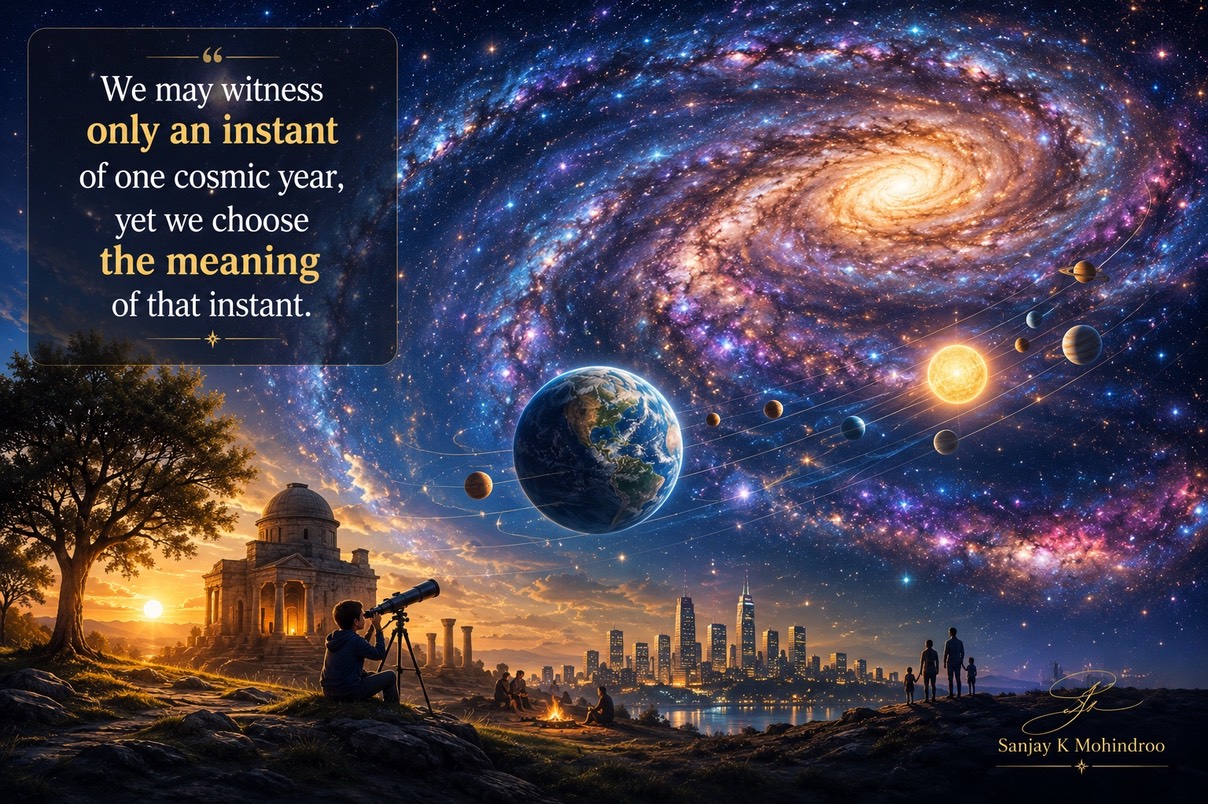
Yet while we answer emails, celebrate birthdays, or make plans for the weekend, the entire solar system is travelling through the Milky Way at incredible speed. Earth is not sitting quietly in space. It is orbiting the Sun, while the Sun carries every planet around the centre of our galaxy.
That galactic journey takes roughly 230 million years to complete.
Astronomers call this a cosmic year.
It is a number so immense that the human mind struggles to grasp it. Still, once that timescale settles into our imagination, something quietly changes. We begin looking at our own lives a little differently.
The Universe Keeps an Older Calendar
A clock measured in millions of years
Imagine opening a history book that begins not with the first civilisation, but with the formation of Earth.
Now imagine compressing every recorded chapter of human history into the final few seconds before midnight.
Against a cosmic year, humanity has barely arrived.
The last time our solar system occupied its current position in the Milky Way, dinosaurs roamed forests that no longer exist. The Himalayas had not reached their present height. Continents were arranged differently. Mammals remained small, and no human had ever looked up at the stars with curiosity.
Since then, entire ecosystems have appeared and disappeared.
Species have risen and vanished.
Civilisations have flourished, faded, and left only fragments behind.
Yet throughout all of it, the Milky Way has continued its quiet rotation.
That thought does not diminish our importance. It simply reminds us that the universe measures time with remarkable patience.
Every Lifetime Becomes More Precious
A brief moment filled with lasting meaning
People often hear astronomical numbers and assume they make human existence feel insignificant.
The opposite tends to happen.
Recognising that we experience only a tiny fraction of one cosmic year gives greater value to every conversation, every friendship, and every opportunity to create something meaningful.
A lifetime may seem brief against hundreds of millions of years, yet meaning has never depended on duration.
A teacher may influence generations through one lesson.
A scientist may spend decades studying a single question that changes medicine forever.
An artist may create work that continues speaking to people centuries later.
Their contributions occupy only a brief instant on the universe's timeline, but their impact stretches far beyond their own lives.
Time measures existence.
Purpose measures significance.
Perspective Changes Everyday Decisions
Small worries begin finding their proper place
Modern life encourages urgency.
Notifications demand immediate attention.
Deadlines seem overwhelming.
Minor inconveniences often feel larger than they truly are.
Looking at the Milky Way does not erase those responsibilities, but it gently rearranges their importance.
The email that caused stress this morning will probably be forgotten next month.
The meeting that seemed critical may never be remembered next year.
The difficult season that feels endless today may become a story that shapes someone's wisdom tomorrow.
Astronomy offers more than scientific facts.
It quietly teaches emotional perspective.
Standing beneath a clear night sky reminds us that our challenges exist within something far larger, while also reminding us that our choices still matter deeply.
Those two ideas comfortably coexist.
Curiosity Connects Every Generation
Questions that never grow old
Thousands of years ago, people looked toward the same stars without telescopes, satellites, or spacecraft.
They wondered about the lights scattered across the darkness.
Those questions never disappeared.
Instead, they inspired mathematics, navigation, philosophy, engineering, physics, and astronomy.
Eventually, curiosity carried humanity beyond Earth itself.
Today, observatories map distant galaxies, robotic spacecraft explore neighbouring planets, and powerful telescopes capture light that has travelled for billions of years before reaching us.
Every new answer produces another question.
That endless cycle may be humanity's greatest strength.
Curiosity builds bridges between generations.
One child looking through a telescope today may become the scientist who answers tomorrow's biggest mystery.
The Milky Way Offers Quiet Optimism
Movement without hurry
Nature rarely rushes.
Trees require decades to mature.
Coral reefs develop over centuries.
Mountains rise over millions of years.
Galaxies continue their graceful motion across unimaginable spans of time.
The Milky Way reminds us that meaningful progress often happens gradually.
Growth rarely announces itself in dramatic moments.
It appears through consistent effort, thoughtful choices, and patience.
That lesson applies just as comfortably to personal development as it does to scientific exploration.
The universe has never hurried its own story.
Perhaps we do not always need to hurry ours.
One Orbit Shared by Every Generation
A reminder carried through the stars
Long after today's headlines have faded, the solar system will continue its steady journey around the centre of the Milky Way.
Every generation will occupy only a tiny fraction of that orbit.
Yet within those brief moments, people will continue falling in love, raising families, writing books, solving problems, building communities, asking questions, and reaching toward the stars.
That may be the most beautiful part of our existence.
We are temporary travellers aboard an ancient journey, yet we possess the remarkable ability to fill our short stretch of that voyage with kindness, imagination, curiosity, and purpose.
The Milky Way will never remember our names.
People might.
And perhaps that is enough.
Throughout this shared journey, #Astronomy, #MilkyWay, #SolarSystem, and #SpaceScience continue reminding us that perspective is one of the greatest gifts science offers. Every new observation fuels #Curiosity, strengthens #STEM, encourages #ScienceCommunication, and inspires #Learning, helping us appreciate both the vast universe and the meaningful lives we build within it.