

Did You Know
Bigger Than Imagination: The Blue Whale, Nature’s Largest Masterpiece.

Sanjay K Mohindroo
The blue whale is the biggest animal ever to live. Yes—bigger than dinosaurs, too.
A Creature Beyond Scale
Just How Big Is the Blue Whale?
Let’s not tiptoe into this—blue whales are massive. No, massive. The largest blue whales can stretch up to 100 feet long. That’s longer than a basketball court. They can weigh up to 200 tons. That’s roughly 33 elephants, or 2,667 average adult humans. Or... let’s say it’s heavy.
Their tongue alone? That weighs as much as an elephant. Their heart? The size of a small car.
Now that’s a big-hearted animal. Literally. 🫀 #bluewhale #largestanimal #naturefacts
The Record Holder
The Largest Animal Ever.
Here’s the showstopper: the blue whale isn’t just the largest animal alive today. It’s the largest animal ever to exist. Yes, that includes dinosaurs. Even the mighty Argentinosaurus, one of the biggest known dinosaurs, doesn’t outweigh the blue whale.
And unlike many dinosaurs, blue whales aren’t bones in a museum. They’re alive. Right now. Swimming in the deep blue. Singing, breathing, moving. Living giants in our world. #oceanlife #naturalwonders #livinglegend
Power Meets Grace
Not Just Big. Beautiful.
Despite their size, blue whales are elegant. They glide through the water with calm precision. No frantic splashing. No flailing. Just smooth, slow, confident movement.
Their blue-gray skin glows with speckles of lighter shades, often appearing blue underwater because of the light. It’s almost otherworldly. And when that giant tail flicks the surface before a deep dive, it’s poetry in motion.
They don’t shout for attention. They just are. And that’s more than enough. #oceanbeauty #gracefulgiants #majesticwhale
A Voice That Carries Miles
Their Songs Can Cross Oceans.
Blue whales are loud. Not loud like your neighbor’s car stereo at 2 a.m.—we mean planet-shaking loud. Their vocalizations can reach up to 188 decibels. That’s louder than a jet engine.
But these aren’t just noise. Blue whale songs travel for hundreds—sometimes thousands—of miles. They use their deep, low-frequency sounds to communicate across vast ocean ranges. Some calls are rhythmic. Others, haunting. All are powerful.
And we’re only just starting to understand what they’re saying. #whalesongs #underwatercommunication #animalintelligence
The Diet of a Giant
How Do You Feed 200 Tons of Whale?
They may be the biggest, but they eat some of the smallest. Blue whales feed mostly on krill, tiny shrimp-like creatures. During feeding season, a single whale can eat up to 4 tons of krill. Per day.
Here’s how: they take a massive gulp of water—think Volkswagen-sized—and then filter out the krill using their baleen plates. It’s a whale-sized strainer.
It’s like nature’s biggest gentle giant on a soup cleanse. Only the soup is alive. #marineecology #feedinghabits #bluewhales
Born Big, Grow Bigger
Even Baby Blue Whales Are Huge.
A newborn blue whale calf is around 20–25 feet long at birth. That’s longer than an SUV. And it weighs about 3 tons. In its first year, it gains up to 200 pounds per day, thanks to its mother’s milk, which is about 50% fat.
Imagine growing that fast. If humans grew at that rate, a newborn would hit 1,600 pounds before kindergarten. That’s wild. #marinebiology #babywhales #oceanwonders
Giants in Trouble
Their Size Doesn’t Make Them Safe.
Despite their scale, blue whales aren’t invincible. They were hunted nearly to extinction during the 20th century. Whale oil was a hot commodity, and these giants were easy targets for whalers.
Before whaling, there may have been over 300,000 blue whales worldwide. Now? Only about 10,000 to 25,000 remain.
Ship strikes, pollution, noise interference, and climate change all still threaten their survival. That’s a heavy burden for something so magnificent.
#conservation #savethewhales #oceansmatter
Protecting the Gentle Giants
Why Blue Whales Need Our Voice.
International bans on whaling have helped. Marine protected areas give them some space. But we can do more.
By reducing ocean noise, cutting down ship speeds, and enforcing clean ocean practices, we make their lives easier. Sharing awareness helps too. Because the more people who see these giants, not just in videos but in their minds, the more people who care.
And when people care, things change. #protectbluewhales #oceanconservation #actionmatters
Why the Blue Whale Inspires Us
A Reminder of What’s Possible.
The blue whale is more than a record-breaker. It’s a symbol. Of endurance. Of quiet strength. Of beauty that doesn’t scream for attention.
In a world of noise and hustle, the blue whale reminds us to move with purpose, to make a lasting impact without always being loud.
And maybe most of all, it reminds us of how little we know about the deep. How much wonder still lives out there. How lucky we are to share a planet with something this amazing.
So, if you're ever feeling small, remember: you're on the same planet as the biggest thing that ever lived.
And that’s worth smiling about. #inspiration #bluewhalemagic #planetearth
Still Swimming. Still Amazing.
The blue whale’s story isn’t just a fact for textbooks. It’s a live broadcast of nature’s power, still going, still breathtaking. We can’t all be 100 feet long and weigh 200 tons—but we can all be awe-inspiring in our way.
Whether you're deep into marine science or just love an awesome animal fact, the blue whale delivers. No exaggeration needed.
Let’s keep talking about them. Let’s protect them. Let’s be better—for them, and for every creature that calls this spinning blue marble home.
#bluewhalesrock #biggestanimal #oceanlovers
More Trees Than Stars: A Planet Overflowing with Life.

Sanjay Mohindroo
Earth has more trees than stars in the Milky Way. Here's why that fact is powerfully inspiring.
The Cosmic Surprise
A Fact That Blows Minds and Shifts Perspectives
Let’s get straight to the point: Earth has roughly three trillion trees. That’s 3,000,000,000,000. The Milky Way, our galactic home, holds an estimated 100 to 400 billion stars. That means trees outnumber stars by at least seven to one, possibly even more.
Let that sink in.
The universe is vast. But Earth—our green, blue, breathing home—holds something just as majestic. Trees. Towering, tiny, twisted, symmetrical. Anchored in soil but reaching for the skies.
This isn’t just trivia. It’s a perspective shift. #TreesOverStars #EarthIsExtraordinary
Counting the Uncountable
How Do You Even Count Trees and Stars?
It’s fair to ask—how do we even know how many trees or stars exist?
Counting Trees
In 2015, scientists led by Yale University used satellite data, forest inventories, and advanced algorithms. They came up with a figure: around 3 trillion trees across the planet.
That study stunned scientists. They had previously estimated only 400 billion trees. The real number turned out to be eight times higher. Talk about undershooting.
Counting Stars
Meanwhile, counting stars is trickier. We can’t travel the galaxy with a clipboard. Astronomers estimate based on mass, star density, and our galactic structure. The average sits around 100–400 billion stars in the Milky Way.
Bottom line? We’re sure about one thing: Earth’s trees win in numbers.
#TreeMath #StarMath #ScienceRocks
Why This Fact Matters
It’s More Than Numbers. It’s a Wake-Up Call.
This comparison isn’t just a fun stat to throw around at parties. It’s a statement about life.
The Milky Way is awe-inspiring. But our planet holds more individual living trees than stars in that entire galaxy. That’s life, not just a matter. That’s rooted, breathing, growing life. It speaks to Earth’s fertility, diversity, and resilience.
It also throws cold water on the tired idea that Earth is "just a small speck." It’s small, yes—but mighty. Vibrant. Overflowing.
#LoveYourPlanet #EarthIsAlive
The Magic of Trees
Earth's Crown Jewel
Trees don’t just sit there looking pretty. They’re active players in the drama of life.
Here’s what they do:
• Absorb CO₂ and release oxygen.
• Filter water and stabilize soil.
• Cool cities nurture ecosystems.
• Provide habitat for more species than you can imagine.
They’re the lungs, the umbrella, the fence, the supermarket, and the temple of life on Earth. Every tree is a miniature world.
No star offers shade. No star filters the air. But trees? Trees do it all.
#TreesMatter #PlanetHeroes #LifeGivers
Humanity’s Tree Story
From Worship to Chainsaws
Humans have always had a complicated relationship with trees.
In ancient cultures, trees were sacred. Think of the Norse Yggdrasil. Or the Bodhi tree under which Buddha found enlightenment. Even in modern cities, a big old tree still inspires awe.
But here’s the thing—we’ve also been cutting them down like there’s no tomorrow.
The same study that gave us the 3 trillion figure? It also said we’ve lost nearly half the world’s trees since civilization began.
And we’re still losing about 15 billion trees every year.
Let that sink in, too. #DeforestationCrisis #WakeUpCall
The Power of Restoration
We Can Bring Back the Forests
Now for the good news: Trees can grow back. And they’re doing it.
Reforestation projects across the globe are showing that nature bounces back fast when given the chance.
Ethiopia once planted 350 million trees in a single day. That’s not a typo. Forests in Costa Rica have rebounded thanks to smart policies. Cities are bringing back urban forests. It's happening.
But we can’t just plant and forget. We need to protect, manage, and learn. Reforesting isn’t a trend—it’s a responsibility.
#ReforestTheFuture #NatureHeals
Earth’s Rarity
There's Nothing Like This Out There—Yet
We haven't found a single planet like Earth. Not even close.
Sure, astronomers have spotted exoplanets in the "habitable zone." But we haven’t found life. Not trees. Not bacteria. Nothing.
Earth isn’t just a speck. It’s a miracle of abundance. Trees are a reminder of that miracle.
They whisper, “This place is rare. Treat it right.” #OnlyOneEarth #TreeWhispers #PlanetPride
What This Tells Us About Hope
Life Finds a Way—Billions of Times Over
This tree vs. star fact gives us something science rarely hands out: hope.
It proves that life, when given the right conditions, doesn’t just survive. It thrives. It multiplies. It fills every nook and cranny.
When we worry about climate change, extinction, or pollution, let this remind us:
Life is powerful. And we’re part of it.
Let’s not be the problem. Let’s be the comeback story.
#GreenHope #LifeFindsAWay #WeBelong
Look Up. Then Look Around.
Stars are beautiful. Distant. Majestic.
But trees? Trees are here. You can touch them. Climb them. Sit beneath them. Listen to the wind through their leaves.
Trees don’t ask for attention. They just give. Shade. Air. Life. A trillion times over.
So, the next time you gaze at the stars, remember:
There’s something more numerous. And maybe more amazing. Right here at your feet. #TreeLove #LifeIsBeautiful #EarthIsEnough
Breaking Free from the 10% Brain Myth: Unleashing Your Mind’s True Power.

Sanjay Mohindroo
Bust the 10% brain myth, explore true neural function, and learn to energize and expand your mind’s boundless potential. #BrainHealth
Why the 10% Myth Persists
First, you’ve probably heard that we only use ten percent of our brain. That idea feels daring and sparks hope. Yet it lacks any scientific backing. Despite decades of research, no evidence supports that claim. Instead, modern tools reveal an organ in full use. Still, the myth lives on in movies, ads, and casual chat. So, let’s shine a light on real brain function. Then we can tap into our full mental power. #MindPower
Mapping the Brain’s Landscape
A Tour Through Neural Networks
Next, imagine your brain as a city at night. Millions of lights blink on every street. Those lights are neurons sending signals. Each signal carries thought, feeling, or motion. Functional MRI scans measure blood flow and electrical patterns. They show nearly all regions active, even during rest. That constant hum debunks any unused swath. As you read this, your visual, language, and memory areas work in sync. Each region connects through pathways that no single percent can capture. #CognitiveCapacity
Debunking the 10% Myth
Evidence Shows We Use It All
Then, consider what happens when parts break. Even small injuries affect speech, sight, or mood. If ninety percent lay idle, damage would barely show. Instead, every zone plays a role. Studies in animals confirm this. Removing bits of cortex alters behavior right away. Moreover, the brain burns twenty percent of your calories. Would it fuel dormant tissue? That level of energy use demands a function. In short, the 10% idea fails tests in anatomy, physiology, and energy use. #NeuralEfficiency
Unlocking Unlimited Potential
How Practice Shapes Capacity
Meanwhile, here’s the exciting part: your brain adapts. It rewires itself with new tasks. Scientists call this process neuroplasticity. When you learn a skill, your brain strengthens key links. Musicians show thicker regions for finger control. Bilingual speakers grow richer language zones. That growth appears on scans as you practice. No fixed limit caps your learning. Instead, your choices set the pace. A curious mind fires new circuits. Challenges fuel new growth. As you push yourself, your brain expands its reach. #GrowthMindset
Energize Your Brain Daily
Fuel, Rest, and Challenge
After you build those circuits, you must care for them. First, feed your brain. Healthy fats in nuts, seeds, and fish keep cell membranes strong. Lean proteins supply building blocks for key messengers. Antioxidants in berries and dark greens fight cell wear. Don’t forget water. Your brain needs fluid to carry nutrients.
Next, rest is crucial. Sleep clears toxins and cements memory. Shoot for seven to nine hours each night. A short nap can boost alertness and mood.
Then, challenge your mind. Puzzles, strategy games, and hobby projects spark fresh pathways. Learning a language or a new skill wakes up idle networks. Balance fuel, rest, and challenge. That trio keeps your brain alert and ready. #BrainEnergy
Boost Your Brain’s Reach
Strategies to Expand Capacity
First, use deliberate practice. Set clear, small goals. Track progress. Tackle one skill step by step.
Next, focus deeply. Block distractions. Try short sprints of intense work. Give your full attention.
Then, cross-train mentally. Switch among activities—learn music, code, and writing. Each skill feeds the others.
Also, teach what you learn. Explaining ideas cements them. Join a group or start a blog.
Don’t skip daily exercise. Movement raises growth factors that aid memory. Even a brisk walk lifts your power.
Finally, manage stress. Try simple breathing drills or brief meditation. Lower stress hormones to guard neural health.
Each tactic taps hidden reserves. Use them regularly to shock your brain into new levels. #MaximizeYourMind
Embrace Your Mental Power
At last, the ten-percent myth has no place in a forward-thinking view. Your brain runs near full capacity every day. Yet your true range depends on how you train it. Feed it smart fuel. Rest it well. Challenge it often. Then watch your potential unfold. Your mind offers boundless promise. That promise begins when you choose to act.
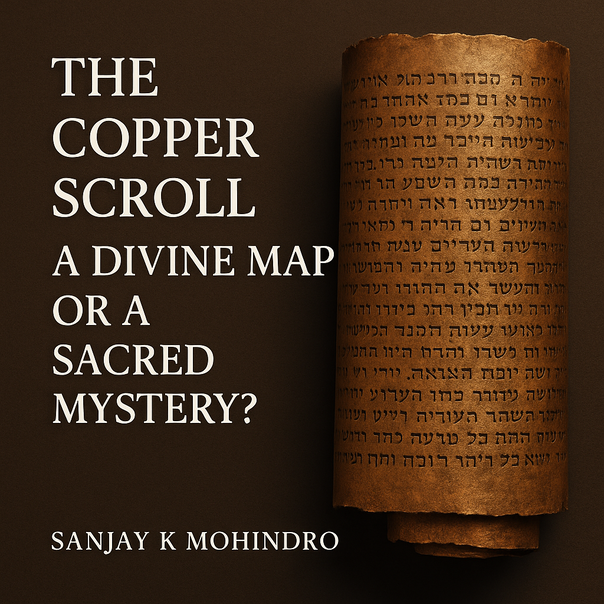
The Copper Scroll: Treasure Map or Ancient Riddle?
Sanjay Mohindroo
Discover the secrets of the Copper Scroll—an ancient Dead Sea artifact listing hidden treasures. Is it a physical map to gold or a spiritual ledger of sacred inheritance?
In the sun-scorched hills near the Dead Sea, a peculiar discovery sent shockwaves through history. Not a parchment, but a copper scroll—etched with what seemed like a list of hidden treasures, sacred vessels, and clues that echo through biblical prophecy. Unlike anything found before, the Copper Scroll invites us into a mystery that spans centuries. Is it just ancient inventory—or something far more divine? This post explores its origins, theories, and powerful spiritual implications.
"Not all treasure is silver and gold, mate." — Captain Jack Sparrow
But sometimes… it might just be.
In the arid cliffs of Qumran near the Dead Sea, a strange discovery was made in 1952—one that still puzzles archaeologists, theologians, treasure hunters, and conspiracy theorists alike. Unlike the hundreds of parchment and papyrus scrolls discovered before it, this one wasn’t meant to disintegrate in your hands. It was made of copper.
That’s right. The Copper Scroll, an ancient relic that reads more like a pirate’s treasure map than a religious manuscript, may be the most compelling mystery from the Dead Sea Scrolls cache. And while most ancient texts offer spiritual guidance, prophecy, or law, this one speaks plainly and specifically about something else entirely:
Treasure. Lots of it. Hidden. Buried. Forgotten.
What Exactly Is the Copper Scroll?
Discovered in Cave 3 at Qumran in 1952, the Copper Scroll is part of the broader discovery known as the Dead Sea Scrolls—a collection of Jewish texts dating back to the Second Temple period (circa 3rd century BCE to 1st century CE). But the Copper Scroll (#CopperScroll) stands apart for several reasons:
Material: It’s made of copper mixed with tin, not papyrus or parchment like the rest.
Purpose: It lists 64 different hidden locations of gold, silver, and other precious items.
Tone: It’s factual, almost bureaucratic—more “bank ledger” than “biblical sermon.”
It consists of two rolls, initially found as a single scroll that was too brittle to unroll. To read it, researchers at the University of Manchester had to cut it into 23 segments using a saw. Risky? Absolutely. Necessary? Unfortunately, yes.
The Text: A Treasure Hunt in Ancient Hebrew
The Copper Scroll doesn’t mince words. It dives straight into business. Here’s an example:
“In the ruin that is in the valley of Acor, under the steps, with the entrance at the East, a distance of forty cubits: a chest of silver and its vessels, with a weight of seventeen talents.”
This isn’t a poetic metaphor. It’s GPS directions, first-century style. These 64 entries provide details about:
• The location (caves, cisterns, courtyards, etc.)
• Measurements (cubits, steps, depths)
• Contents (talents of gold/silver, scrolls, sacred vessels)
It’s effectively a buried treasure map—possibly the oldest one we’ve got.
Some Stats:
• Weight of hidden silver: Estimated over 4,600 talents (~160 tons)
• Value in today’s money: Easily in the billions of dollars
• Mystery solved? Not even close. #AncientMystery #HistoricalEnigma
Who Wrote It—and Why?
Here's where we tread into murky, fascinating waters. Theories abound, but none are universally accepted. Let’s explore the most popular ones:
1. The Essenes’ Emergency Vault
The prevailing theory associates the scroll with the Essenes, a strict Jewish sect that inhabited Qumran. When the Roman Empire turned up the heat, particularly during the First Jewish-Roman War (66–73 CE), the Essenes may have hidden Temple treasure across the desert for safekeeping.
· The Copper Scroll could be a record for retrieval after the conflict.
· It might be linked to Second Temple artifacts, possibly looted or rescued before Rome sacked Jerusalem in 70 CE.
· Some believe it was meant for the Messiah to find when the time was right.
If this were a stash of Temple treasures, it would explain the sacred tone around seemingly mundane gold and silver.
2. A Hoax or Red Herring?
Some skeptics argue that the scroll is wishful thinking—a symbolic document or even an elaborate decoy:
• The Hebrew style is unusual, closer to Mishnaic Hebrew than biblical.
• No treasures have been found at the locations mentioned.
• It could be a moral or apocalyptic allegory, representing spiritual wealth.
This doesn’t sit well with literalists. But it’s important to keep our historical hats on: not everything written was meant to be taken at face value.
3. Temple Priests on the Run
A third theory suggests that this was written by Temple priests, who were trying to protect sacred assets from invading Roman forces. If true, the list could be tied directly to Second Temple rituals, making the treasure less about wealth and more about preserving Jewish identity under threat.
#DeadSeaScrolls #AncientJudaism #SecondTemple
Where’s the Treasure?
Ah, the million-dollar—actually, multi-billion-dollar—question.
Despite multiple efforts, no confirmed treasure listed in the Copper Scroll has ever been recovered. That’s not for lack of trying.
Notable Search Attempts:
· John Marco Allegro, a scholar (and sensationalist), led expeditions in the 1950s with the belief that the scroll was literal. He even involved British and Jordanian forces in excavation efforts. Result: zilch.
· Treasure hunters and private adventurers have tried their hand. Many claim to have found clues, but nothing conclusive has surfaced.
· Modern archaeologists have revisited the scroll with 3D scans, infrared imaging, and cross-referenced location data—but no golden chests unearthed… yet.
Theories on Why It Hasn’t Been Found:
· The locations may be lost or destroyed over time.
· The units of measurement may have been misunderstood.
· The treasures might have been retrieved already by the Romans, Crusaders, or others.
· It may require a code or key, possibly hidden in another scroll.
Still, the allure remains. As long as the treasure stays hidden, imagination will do the heavy lifting. #TreasureHunt #BiblicalHistory #LostGold
Implications: More Than Just Gold
The Copper Scroll forces us to reconsider what we think we know about ancient Jewish society, the Second Temple, and the very function of the Dead Sea Scrolls themselves.
1. Not Just Religious Texts
Most Dead Sea Scrolls are theological or philosophical. The Copper Scroll? It’s logistical. That alone challenges the narrative that Qumran was solely a monastic, religious retreat.
It implies:
• Advanced record-keeping
• Property ownership or asset management
• Possibly a wider political and economic influence
2. Temple Wealth Confirmed?
The sheer volume of treasure suggests the Second Temple had vast wealth, far beyond what was previously understood. If this scroll is accurate, it may validate Josephus’s historical writings about the riches of the Temple.
3. Rewriting the Narrative
Was the Copper Scroll part of an escape plan? A community ledger? A coded message for a future generation?
Any of these options shifts the story of Jewish resilience and strategy in the face of Rome’s destruction. It speaks to a community that planned for survival, possibly even rebirth.
#HistoricalRevelation #QumranCaves #LostTemple
Modern Interpretations and Cultural Echoes
The Copper Scroll has bled into popular imagination, right alongside the Ark of the Covenant and the Holy Grail. It’s inspired:
• Novels and thrillers (think Dan Brown meets ancient history)
• Documentaries and YouTube rabbit holes
• Archaeological quests (some funded, many not-so-much)
And perhaps more importantly, it continues to provoke new questions in a world hungry for both mystery and meaning.
What if there is a treasure? What if it was already found… and hidden again?
What if the treasure was spiritual all along?
#BiblicalMystery #CopperCode #LostAndFound
Truth, Treasure, and Timeless Questions
The Copper Scroll is one of those rare archaeological finds that offers more questions than answers—and that’s exactly why it’s so captivating.
Whether it's a literal map to billions in treasure, a coded priestly document, or an elaborate allegory, the Copper Scroll invites us to think differently about the past. To imagine a time when spiritual devotion and physical wealth were intertwined. A time when communities took extraordinary risks to preserve not just texts, but their legacy.
As we unroll more layers of history—digitally, linguistically, and geographically—the truth may still be out there.
Until then, the Copper Scroll remains what all great mysteries should be:
• Unresolved
• Underrated
• And undeniably magnetic
Want More Like This?
If this kind of historical deep dive ignites your curiosity, stay tuned for future posts on the Ark of the Covenant, the Temple Mount theories, or lost relics of antiquity.
In the meantime, keep digging. 🗺️