

Did You Know
A Sacred Chamber, A Shared Human Longing

Sanjay Mohindroo
The Garbhagriha and the Holy of Holies reveal a striking spiritual parallel rooted in silence, presence, and devotion.
A traveler once stood inside an ancient Indian temple at dawn. The halls were quiet. The stone walls carried centuries of prayer. At the heart of the temple sat the Garbhagriha, a small and dark inner chamber.
Years later, while reading about the Temple of Jerusalem, the traveler paused. The description felt familiar. Deep within that sacred structure stood the Holy of Holies, a hidden space reserved for divine presence.
Separated by geography, culture, and time, these sacred spaces seemed to speak the same language.
The Journey Inward
Sacred design shaped around presence
Ancient builders rarely placed the most sacred place at the entrance.
In Hindu temples, worshippers move through halls and corridors before reaching the Garbhagriha. The path slows the mind and prepares the heart. Each step feels intentional.
The Holy of Holies carried a similar purpose. It stood at the innermost point of the Temple. Access remained limited, emphasizing its sacred nature and spiritual weight.
The design was not about distance alone. It was about focus.
Both spaces suggest that true spiritual connection often begins with an inward journey.
#SacredArchitecture #SpiritualHeritage
Silence at the Center
Stillness carrying greater meaning than words
The first thing many visitors notice inside a Garbhagriha is its simplicity.
The chamber is often small, dimly lit, and free from distraction. Attention naturally settles on the deity within. The outside world fades away.
Descriptions of the Holy of Holies create a similar image. It represented the dwelling place of God's presence. Its power came not from noise or display but from sacred stillness.
This shared idea feels striking.
Many traditions use prayer, song, and ritual. Yet at the deepest point, silence often becomes the language of faith.
The lesson reaches beyond religion. In a busy age, quiet spaces still hold rare value.
A Meeting Point Between Human and Divine
Faith expressed through sacred boundaries
The Garbhagriha means "womb chamber." The name itself carries deep symbolism. It represents creation, life, and divine presence.
The Holy of Holies carried a similar sense of sacred separation. It marked a space set apart from ordinary activity. The boundary itself reflected respect and reverence.
A visitor may see walls, doors, and rituals.
A believer sees something else.
They see a meeting point between the human and the divine.
Different faiths express this idea in unique ways. Yet the underlying message feels familiar. Sacred encounters deserve preparation, attention, and humility.
That shared understanding creates a bridge between traditions rather than a barrier.
#FaithAndCulture #SharedHeritage
Ancient Wisdom Across Civilizations
Parallel ideas emerging from distant lands
The most fascinating part of this story is not architecture.
It is human nature.
Ancient India and ancient Israel developed in different settings. Their languages, customs, and beliefs followed separate paths. Yet both traditions placed a sacred chamber at the heart of worship.
This parallel invites reflection.
People across cultures have long searched for meaning, connection, and presence. They built spaces that reflected those hopes. The Garbhagriha and the Holy of Holies stand as reminders of that shared search.
They show that while traditions differ, many spiritual questions remain universal.
The Garbhagriha mirrors the Holy of Holies in a way that feels both surprising and natural.
Each stands at the heart of a sacred structure. Each invites silence, reverence, and reflection. Each represents a space where the ordinary gives way to something greater.
Their similarity is not merely architectural.
It reveals a timeless human desire to draw closer to the divine.
Across centuries and cultures, people built sacred centers that reflected the same truth: the deepest journeys often lead inward.
When a Planet Rewrites Our Sense of Time
Sanjay Mohindroo
A remarkable fact about Venus opens a wider conversation about science, perspective, and the many ways the universe surprises us.
A day on Venus lasts longer than a year. Explore the science, perspective, and lessons behind this extraordinary Venus fact.
A Sentence That Sounds Impossible
Now and then, a single sentence has the power to pause our thoughts.
A day on Venus lasts longer than a year on Venus.
Most people instinctively reject it. Our everyday experience tells us that a day is only a small fraction of a year. It feels like one of those riddles designed to trick us.
Yet it is completely true.
That simple fact is more than an astronomical curiosity. It reminds us that many of the assumptions we carry through life exist only because of the tiny corner of the universe we call home.
The moment we step beyond Earth's familiar rhythm, time begins to tell a very different story.
A Planet That Refuses Familiar Patterns
An Unexpected Dance Around the Sun
Imagine watching two clocks.
One measures the time it takes a planet to rotate once on its axis. The other measures the time required to complete one orbit around the Sun.
On Earth, the first clock finishes long before the second. We experience one rotation every twenty-four hours and one orbit every 365 days.
Venus breaks that pattern completely.
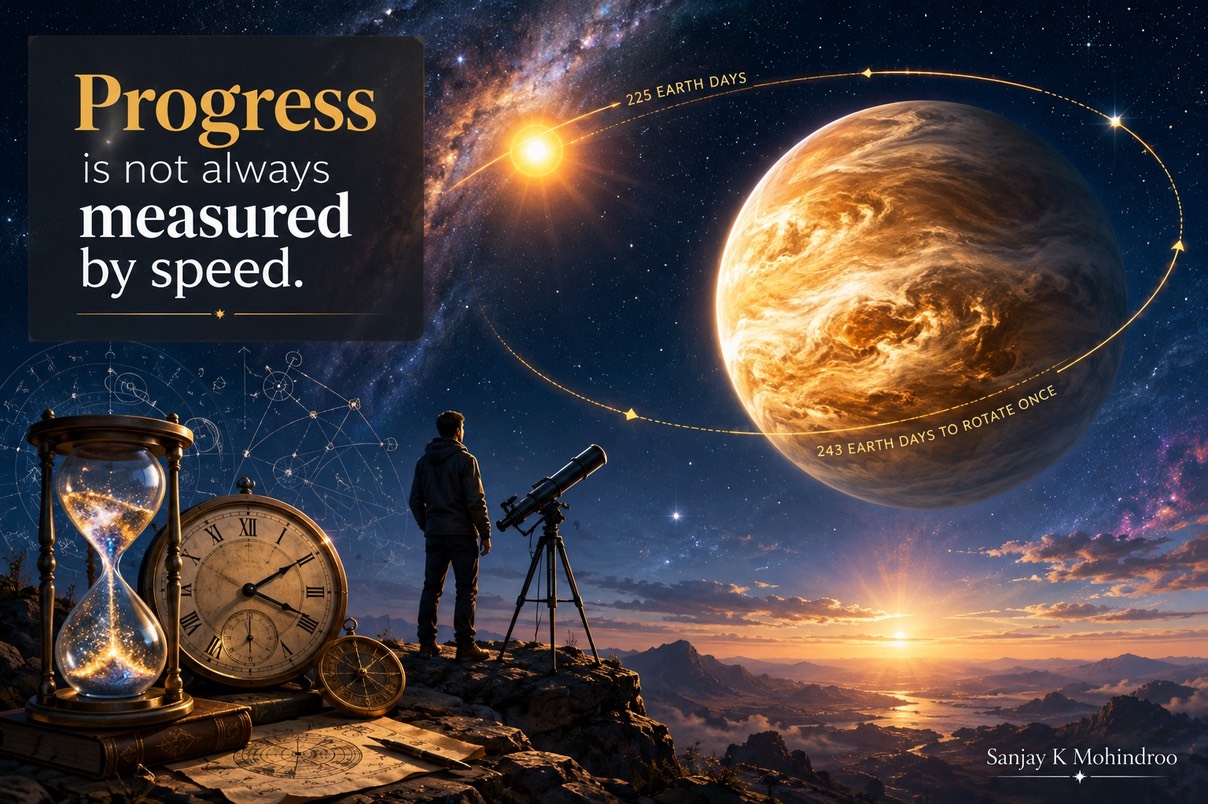
The planet takes about 243 Earth days to rotate once, yet it circles the Sun in approximately 225 Earth days.
In other words, Venus completes an entire trip around the Sun before it finishes a single rotation.
That extraordinary relationship exists because Venus spins exceptionally slowly. Even more intriguing, it rotates in the opposite direction to most planets in our solar system. If you stood on its surface, the Sun would appear to rise in the west and set in the east.
Science often feels exciting because it answers questions. Moments like this remind us that it is equally exciting because it asks us to rethink ideas we never questioned in the first place.
Earth Is Only One Reference Point
Perspective Quietly Shapes Reality
Human beings naturally treat Earth as the standard for everything.
Our calendars are based on Earth's orbit.
Our clocks follow Earth's rotation.
Our seasons reflect Earth's tilt.
Even our language carries those assumptions. We speak about "days," "years," and "months" as though they represent universal truths.
They do not.
They simply describe our experience on one planet.
If an intelligent civilization had developed on Venus, its understanding of time might have looked completely different. Birthdays, calendars, work schedules, festivals, and historical records would all be built around another rhythm.
The universe has no obligation to organize itself around our habits.
That realization extends well beyond astronomy.
Many ideas we consider universal are often products of culture, geography, history, or circumstance. Looking beyond our own reference point frequently reveals possibilities we never imagined.
#Astronomy and #Curiosity often begin with that single shift in perspective.
Slow Motion Does Not Mean Standing Still
Patience Has Its Own Momentum
Modern life celebrates speed.
We admire rapid promotions.
We celebrate overnight success stories.
We expect instant replies and immediate progress.
Yet the natural universe rarely behaves that way.
Stars spend millions of years forming.
Mountains rise over immense stretches of geological time.
Coral reefs grow patiently through countless generations.
Even the spacecraft carrying humanity's greatest ambitions often travel for years before reaching their destinations.
Venus belongs comfortably within that tradition.
Its slow rotation does not prevent it from following the laws of physics. It continues its steady journey around the Sun exactly as expected.
The lesson feels surprisingly familiar.
People often compare their progress against someone else's calendar. Careers, businesses, creative projects, education, and personal goals all appear to move at different speeds.
Nature suggests a quieter measure.
Progress is movement toward a destination, not movement at someone else's pace.
That distinction can change the way we judge ourselves.
The Universe Rewards Curiosity
Small Questions Lead to Bigger Ideas
Many scientific breakthroughs begin with a simple observation that refuses to fit existing expectations.
Astronomers studying Venus noticed its unusual rotation decades ago. Continued observations gradually revealed a richer understanding of the planet's atmosphere, surface, magnetic environment, and geological history.
Curiosity rarely arrives with dramatic announcements.
It begins with someone asking,
"That seems unusual."
Children ask questions because they are curious.
Scientists ask questions because they remain curious.
The difference between the two is often experience, not attitude.
Maintaining that sense of wonder allows us to keep learning long after formal education ends.
That may be one of science's greatest gifts.
It teaches us to remain comfortable saying, "I didn't know that."
A Neighbour Unlike Any Other
Beauty Often Hides Complexity
Venus is frequently called Earth's twin because the two planets are similar in size and composition.
At first glance, the comparison feels appropriate.
Look closer, and the similarities begin to disappear.
Venus has an atmosphere so dense that surface pressure is crushing. Temperatures exceed 460°C, making it the hottest planet in the solar system despite Mercury being closer to the Sun. Thick clouds of sulfuric acid permanently cover the sky, hiding the surface from ordinary view.
Yet amid these extreme conditions sits one of the most elegant astronomical facts ever recorded—a day longer than a year.
That contrast makes Venus unforgettable.
It reminds us that appearances often conceal remarkable stories waiting to be understood.
The same applies to people, ideas, and places.
The first impression is rarely the complete picture.
#SpaceScience continually rewards those willing to look twice.
The Quiet Value of Looking Up
Wonder Never Goes Out of Style
For thousands of years, people have looked at the night sky seeking answers.
Ancient navigators found direction among the stars.
Farmers planned their seasons by observing celestial patterns.
Scientists transformed careful observations into revolutionary ideas.
Today, satellites and space probes allow us to understand distant planets with extraordinary precision.
Yet the emotional experience remains unchanged.
Looking upward reminds us that our daily routines exist within something far larger than ourselves.
A surprising fact about Venus does more than teach astronomy.
It gently expands our imagination.
Every unexpected truth reminds us that certainty is often temporary and that curiosity remains one of humanity's greatest strengths.
A Different Clock, A Lasting Lesson
Venus follows a rhythm unlike our own.
Its day stretches beyond its year.
Its sunrise arrives from an unexpected direction.
Its environment challenges nearly every expectation we formed while growing up on Earth.
Instead of making the universe feel stranger, these differences make it richer.
They remind us that reality is wonderfully varied and that progress, time, and perspective are not confined to a single pattern.
Perhaps that is the quiet lesson Venus offers all of us.
The universe does not ask everything to move alike.
It asks each planet to follow its own path.
People may find comfort in remembering that simple idea.
Our greatest measure is not whether we move at the same speed as everyone else.
It is whether we continue moving forward with curiosity, purpose, and wonder.
#Astronomy #Venus #SpaceScience #ScienceFacts #PlanetaryScience #SpaceExploration #STEM #Curiosity #ScienceCommunication #Learning #Education #Cosmos
The Planet That Could Float
Sanjay Mohindroo
A Cosmic Fact That Changes the Way We See Size
One extraordinary scientific fact reveals that the universe often rewards curiosity more than assumption.
Saturn would float in water because its average density is lower than water. Explore the science and the perspective behind this remarkable fact.
A Moment That Stops Every Conversation
One sentence that sounds impossible
Some facts have a way of stopping a conversation in its tracks.
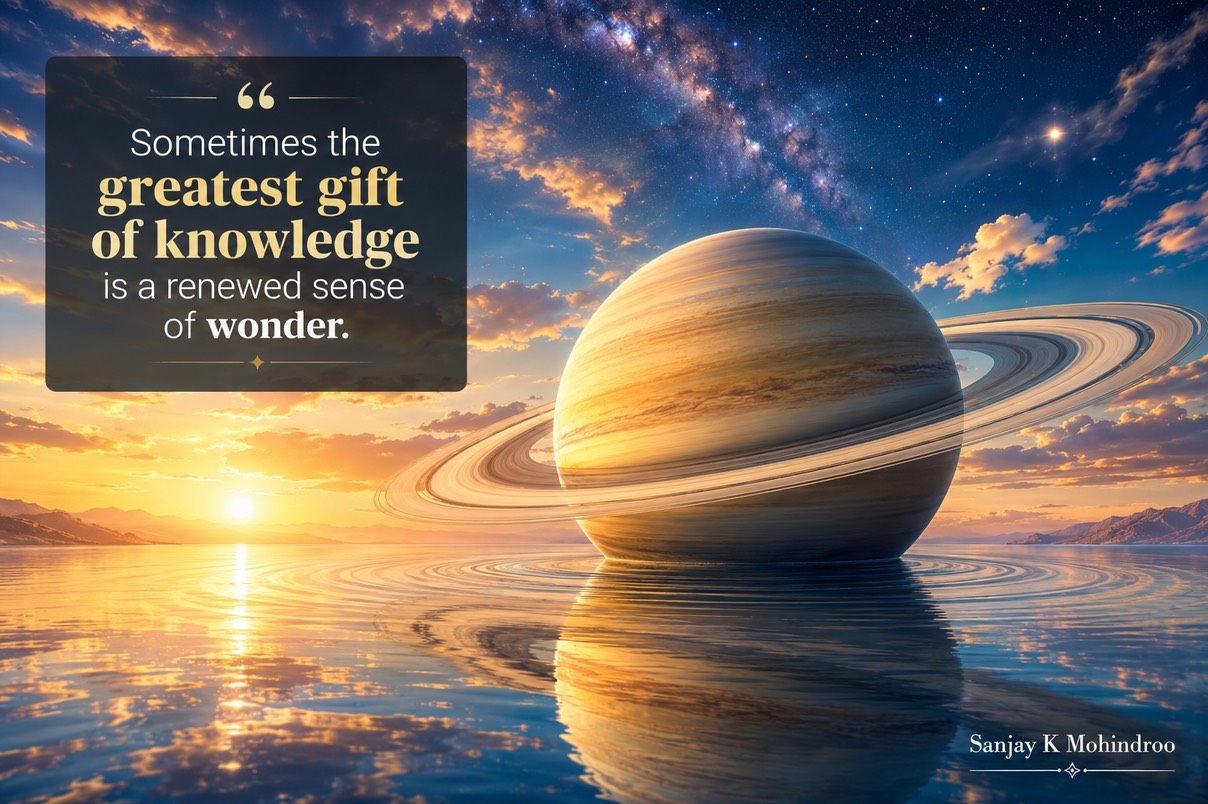
Imagine telling someone that Saturn—the second-largest planet in our solar system—would float in water if a container large enough existed. Most people instinctively reject the idea. They picture an enormous planet wrapped in brilliant rings, powerful enough to influence dozens of moons. Floating seems like the last thing such a giant should do.
Yet that statement is scientifically accurate.
The beauty of this fact is not that it tricks us. It reminds us that intuition is often built on everyday experience, while nature follows rules that are sometimes wonderfully surprising. That small moment of disbelief is the beginning of curiosity, and curiosity has always been one of humanity's greatest strengths. #ScienceFacts #Curiosity
A Number That Tells a Different Story
Mass alone never completes the picture
Our minds naturally connect size with heaviness.
A mountain feels heavier than a rock. A truck outweighs a bicycle. These comparisons work because our daily experiences rarely require us to think about density.
Density simply measures how much matter occupies a given volume. Two objects can be similar in size yet contain very different amounts of material. A steel cube and a wooden cube may look identical, but one sinks while the other floats because their densities are different.
Saturn follows the same principle on a spectacular scale.
The planet is composed mostly of hydrogen and helium, elements that are remarkably light. Even though Saturn contains more than ninety-five times Earth's mass, it spreads that material across an enormous volume. Its average density is approximately 0.69 grams per cubic centimetre, comfortably below water's density of about 1 gram per cubic centimetre.
If someone could somehow create an unimaginably large ocean and an equally impossible container, Saturn's average density suggests that it would float.
The experiment will never happen. The idea survives because it transforms a scientific measurement into an unforgettable mental picture. #Astronomy #Physics
A Planet Built Unlike Any Other
Layers that challenge familiar expectations
Thinking of Saturn as a solid object can be misleading.
Unlike Earth, Saturn has no solid surface on which someone could stand. Its outer regions consist largely of clouds and gases, gradually giving way to denser fluids under crushing pressure. Deeper inside, temperatures rise dramatically, and pressure becomes almost unimaginable.
Its famous rings, although visually magnificent, contribute very little to the planet's overall mass. They are made mostly of countless pieces of ice and rock orbiting together in astonishing harmony.
This combination of immense size, light elements, and unusual internal structure gives Saturn characteristics unlike almost anything we experience on Earth.
The more closely scientists study the planet, the more it reminds us that nature rarely fits neatly into familiar categories. #SpaceScience
A Classroom Hidden in the Solar System
Simple comparisons create lasting understanding
Science often becomes memorable when complex ideas are connected to familiar experiences.
Many people struggle to remember numerical values such as density measurements or planetary composition. Yet almost everyone remembers the image of Saturn floating in an enormous ocean.
Teachers have relied on thought experiments for generations because imagination makes abstract concepts easier to understand. Albert Einstein frequently used imagined situations to explore physics long before equations confirmed his ideas.
Saturn's floating story works in much the same way. It gives people a picture they can carry with them, even if the actual experiment remains impossible.
Great science communication is not about making science simpler. It is about making ideas easier to picture without losing their accuracy. #ScienceCommunication #Education
A Quiet Lesson Beyond Astronomy
Appearances often tell only part of the story
The appeal of Saturn's floating secret extends beyond astronomy.
Daily life encourages quick judgments. We assess people within moments of meeting them. Organisations are judged by their size. Ideas are often accepted or dismissed based on appearances rather than substance.
Saturn quietly reminds us that surface impressions rarely reveal the full picture.
A planet that appears overwhelmingly massive carries an average density lower than water. Something that seems impossible becomes perfectly logical once we understand the hidden details.
The same pattern appears in many parts of life. Calm individuals sometimes carry extraordinary determination. Small teams create remarkable innovations. Quiet ideas gradually reshape industries.
Looking beneath appearances often changes the entire conversation.
That habit of looking deeper is one of science's greatest gifts.
#CriticalThinking #Learning
A Sky That Rewards Curiosity
Wonder grows with every unexpected fact
Every generation inherits a slightly clearer view of the universe.
Powerful telescopes reveal new moons, hidden storms, and distant galaxies. Spacecraft return photographs that once belonged only to imagination. Yet the most valuable discoveries are often the ones that change the way people think rather than simply adding another statistic.
Saturn floating in water belongs to that rare group of ideas.
It encourages children to ask another question. It reminds adults that learning never really ends. It demonstrates that scientific literacy is less about memorising facts and more about developing the habit of curiosity.
Every surprising fact becomes an invitation to look upward with fresh eyes.
#STEM #LifelongLearning
A Lasting Reflection
Wonder begins with a willingness to question assumptions
No ocean could ever hold Saturn, and no container could ever be built on such a scale. Yet the image continues to inspire because it transforms an invisible scientific property into something anyone can imagine.
The universe is filled with moments like this—moments that gently remind us that appearances can mislead, assumptions deserve testing and curiosity remains one of our greatest companions.
Perhaps the most valuable lesson is not that Saturn would float.
It is that every remarkable answer begins with someone willing to ask a surprising question.
#ScienceFacts #Astronomy #Space #SpaceScience #Physics #STEM #ScienceCommunication #Education #Curiosity #CriticalThinking #LifelongLearning