

Did You Know
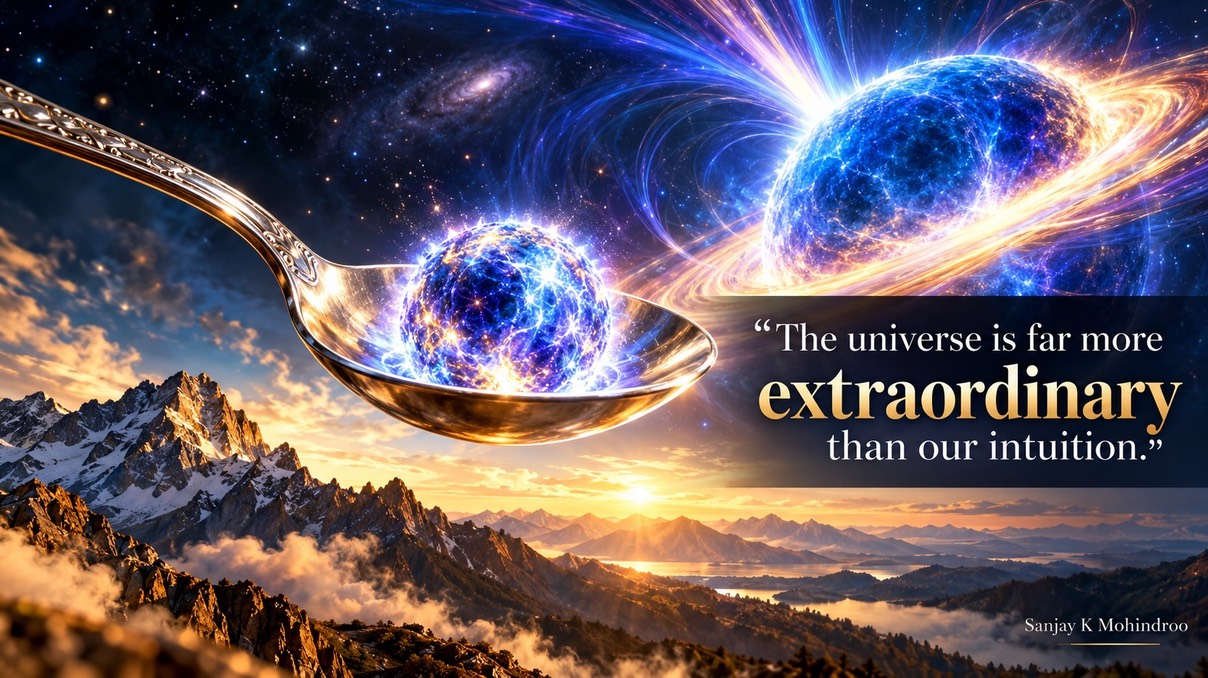
The Cosmic Giant Hidden Inside a Teaspoon
Sanjay Mohindroo
Deep inside the remains of massive stars, gravity compresses matter into forms that challenge nearly everything we experience on Earth.
Meta Description: Explore neutron star density, stellar collapse, and the science behind a teaspoon of matter weighing billions of tons.
A Spoonful of the Extraordinary
Sometimes the most astonishing scientific ideas begin with familiar objects.
There is something reassuring about a teaspoon. It belongs to ordinary life, to morning tea, coffee, medicine, and cooking. We understand its size instinctively.
Now imagine that same teaspoon containing several billion tons of matter.
No familiar substance comes close. Not lead, not gold, not even the densest naturally occurring elements on Earth.
Yet deep in space, nature creates matter so densely packed that a teaspoon-sized volume could possess that extraordinary mass.
This is the remarkable science of neutron stars.
They are not simply unusual astronomical objects. They are natural laboratories for studying gravity, nuclear physics, and the behavior of matter under conditions impossible to reproduce fully on Earth.
And their story begins with a star reaching the end of its life.
The Final Act of a Massive Star
An ending that transforms a luminous giant into an extraordinarily compact remnant.
For millions of years, a massive star survives through a delicate balance.
Gravity pulls its material inward. Energy generated by nuclear fusion helps maintain pressure that resists the collapse.
As the star ages, the nuclear reactions in its core change. In sufficiently massive stars, an iron-rich core eventually forms, and the processes supporting that core can no longer maintain the balance.
Gravity takes control.
The core collapses with extraordinary speed. Under suitable conditions, the collapse contributes to a spectacular supernova explosion that ejects the star's outer layers into space.
But the central remnant may survive.
If its mass falls within the appropriate range, it becomes a neutron star.
A typical neutron star contains roughly 1.4 times the Sun's mass, compressed into a sphere around 20–25 kilometers in diameter.
Consider the contrast. The Sun spans approximately 1.39 million kilometers. A neutron star holds comparable or greater mass within a space small enough to fit across a metropolitan area.
This extreme compression creates the conditions behind one of astronomy's most memorable comparisons.
The Astonishing Density of Neutron Star Material
Billions of tons contained within a volume smaller than a sugar cube.
Ordinary matter feels solid, but its microscopic structure tells a different story.
Atoms contain tiny nuclei surrounded by electrons. Most of an atom's volume lies outside its nucleus.
Under the immense pressure of stellar collapse, matter undergoes a fundamental transformation.
Electrons are driven into protons through processes that produce neutrons and neutrinos. The collapsing core becomes extremely neutron-rich, while powerful nuclear interactions and quantum effects help resist further compression.
The resulting neutron star density can reach values comparable to, and in some regions greater than, the density of an atomic nucleus.
A typical illustrative density is around kilograms per cubic metre.
At that density, a five-milliliter teaspoon-sized volume would contain approximately two billion tons of mass.
ILLUSTRATIVE MASS COMPARISON
Teaspoon of water
5 g
Teaspoon of neutron star matter
2 billion tons
Approximate comparison for a 5 mL volume at a representative neutron star density. Actual density varies within the star.
This is an illustration of #NuclearPhysics at an almost unimaginable scale.
The remarkable point is not merely that neutron stars are heavy. It is that gravity can fundamentally alter the organization of matter.
A City-Sized Object with Extraordinary Gravity
The same force that keeps our feet on the ground becomes overwhelming near a neutron star.
Imagine standing near a neutron star, safely observing it from a distance.
Its surface gravity would be roughly 100 billion times stronger than Earth's, depending on the star's mass and radius.
Light escaping from its surface loses energy as it climbs through the star's gravitational field, a phenomenon called gravitational redshift.
Time also behaves differently. Relative to a distant observer, clocks close to the neutron star run more slowly.
These are not inventions of science fiction. They are consequences of Einstein's general theory of relativity.
Some neutron stars also rotate at extraordinary speeds.
Pulsars, a class of rotating neutron stars, emit beams of electromagnetic radiation that sweep through space. When those beams cross Earth's line of sight, astronomers detect remarkably regular pulses.
Certain pulsars rotate hundreds of times every second.
A compact stellar remnant becomes a cosmic lighthouse, helping scientists test theories of gravity and measure time with exceptional precision.
The Teaspoon That Cannot Exist on Earth
An unforgettable comparison comes with an important scientific qualification.
There is one detail often missing from popular descriptions of neutron stars.
A teaspoon of neutron star material could not simply be transported to Earth and placed on a weighing scale.
The matter exists under immense pressure, maintained by the conditions inside the star.
Remove it from that environment, and it would no longer remain in the same compressed state. Its subsequent behavior would depend on its composition and the conditions of its release.
The familiar claim concerns the mass contained within a teaspoon-sized volume at neutron star densities, not a stable sample that could sit on a kitchen table.
There is also a difference between mass and weight. Tons measure mass, while weight is a gravitational force.
These distinctions make the science more fascinating, not less.
They reveal that the properties of matter depend on its environment, and that even familiar concepts can acquire new meaning under extreme conditions.
Cosmic Collisions and the Origins of Precious Elements
The story of neutron stars extends far beyond their extraordinary density.
In 2017, astronomers observed gravitational waves from the merger of two neutron stars in an event known as GW170817.
Telescopes also detected light associated with the collision, giving researchers a remarkable opportunity to study the event through different kinds of signals.
The observations provided strong evidence that neutron star mergers produce heavy elements through rapid neutron-capture reactions, commonly called the r-process.
These processes contribute to the cosmic origins of elements such as gold and platinum.
It is a beautiful connection.
Some of the precious materials we encounter in jewelry and technology have origins linked to violent events occurring far beyond our solar system.
The same stellar remnants that challenge our understanding of density also help explain the chemical richness of the cosmos.
The #StellarEvolution story does not end when a star stops shining. Its remnants can continue shaping the universe.
The Questions Hidden Deep Inside
Even the densest observable stars preserve mysteries that science has yet to settle.
Despite decades of research, the internal composition of neutron stars remains an active scientific question.
Their outer regions contain extremely dense nuclear matter. Deeper inside, the precise behavior of particles is less certain.
Researchers investigate whether their cores contain exotic particles, unusual nuclear phases, or matter involving deconfined quarks.
Observations of neutron star masses, radii, rotation, and gravitational waves help constrain these possibilities.
Missions such as NASA's Neutron Star Interior Composition Explorer, known as NICER, have contributed measurements that help researchers investigate the relationship between mass, radius, and matter under extreme pressure.
The fascinating aspect of #Cosmology is that every answer can open another question.
Neutron stars demonstrate that even familiar particles may behave in unfamiliar ways when nature pushes them to extraordinary limits.
The Beauty of Thinking Beyond the Familiar
The universe becomes more remarkable when we accept that our intuition has limits.
A teaspoon is an ordinary object. A neutron star is anything but ordinary.
Bringing them together creates a comparison that stretches imagination while remaining grounded in physics.
A few milliliters of matter, under the conditions found inside a neutron star, can represent billions of tons of mass.
Yet the deeper lesson is not about an extraordinary number.
It is about the vast difference between everyday experience and the possibilities permitted by nature.
We live among objects whose size, weight, and behavior feel predictable. Beyond our immediate surroundings, the same physical laws produce stars that rotate hundreds of times per second, bend spacetime, and compress matter to nuclear densities.
Science gives us the language to appreciate these extremes without diminishing their wonder.
And perhaps that is its most uplifting message:
The universe is far more extraordinary than our intuition, and curiosity allows us to reach beyond it.
#NeutronStars #Astrophysics #SpaceScience #Astronomy #Physics #Cosmology #Universe #StellarEvolution #NuclearPhysics #Gravity #ScienceCommunication #ScientificCuriosity