
Sanjay Mohindroo
A remarkable fact about Venus opens a wider conversation about science, perspective, and the many ways the universe surprises us.
A day on Venus lasts longer than a year. Explore the science, perspective, and lessons behind this extraordinary Venus fact.
A Sentence That Sounds Impossible
Now and then, a single sentence has the power to pause our thoughts.
A day on Venus lasts longer than a year on Venus.
Most people instinctively reject it. Our everyday experience tells us that a day is only a small fraction of a year. It feels like one of those riddles designed to trick us.
Yet it is completely true.
That simple fact is more than an astronomical curiosity. It reminds us that many of the assumptions we carry through life exist only because of the tiny corner of the universe we call home.
The moment we step beyond Earth's familiar rhythm, time begins to tell a very different story.
A Planet That Refuses Familiar Patterns
An Unexpected Dance Around the Sun
Imagine watching two clocks.
One measures the time it takes a planet to rotate once on its axis. The other measures the time required to complete one orbit around the Sun.
On Earth, the first clock finishes long before the second. We experience one rotation every twenty-four hours and one orbit every 365 days.
Venus breaks that pattern completely.
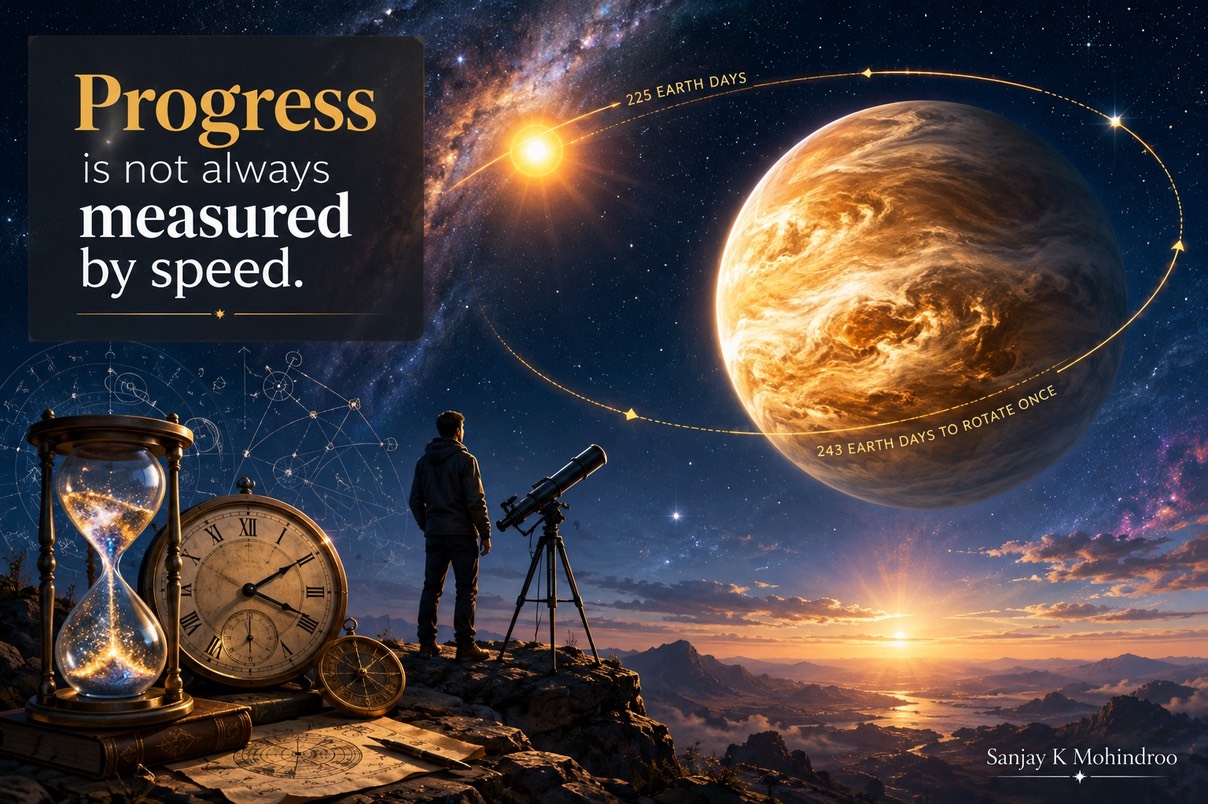
The planet takes about 243 Earth days to rotate once, yet it circles the Sun in approximately 225 Earth days.
In other words, Venus completes an entire trip around the Sun before it finishes a single rotation.
That extraordinary relationship exists because Venus spins exceptionally slowly. Even more intriguing, it rotates in the opposite direction to most planets in our solar system. If you stood on its surface, the Sun would appear to rise in the west and set in the east.
Science often feels exciting because it answers questions. Moments like this remind us that it is equally exciting because it asks us to rethink ideas we never questioned in the first place.
Earth Is Only One Reference Point
Perspective Quietly Shapes Reality
Human beings naturally treat Earth as the standard for everything.
Our calendars are based on Earth's orbit.
Our clocks follow Earth's rotation.
Our seasons reflect Earth's tilt.
Even our language carries those assumptions. We speak about "days," "years," and "months" as though they represent universal truths.
They do not.
They simply describe our experience on one planet.
If an intelligent civilization had developed on Venus, its understanding of time might have looked completely different. Birthdays, calendars, work schedules, festivals, and historical records would all be built around another rhythm.
The universe has no obligation to organize itself around our habits.
That realization extends well beyond astronomy.
Many ideas we consider universal are often products of culture, geography, history, or circumstance. Looking beyond our own reference point frequently reveals possibilities we never imagined.
#Astronomy and #Curiosity often begin with that single shift in perspective.
Slow Motion Does Not Mean Standing Still
Patience Has Its Own Momentum
Modern life celebrates speed.
We admire rapid promotions.
We celebrate overnight success stories.
We expect instant replies and immediate progress.
Yet the natural universe rarely behaves that way.
Stars spend millions of years forming.
Mountains rise over immense stretches of geological time.
Coral reefs grow patiently through countless generations.
Even the spacecraft carrying humanity's greatest ambitions often travel for years before reaching their destinations.
Venus belongs comfortably within that tradition.
Its slow rotation does not prevent it from following the laws of physics. It continues its steady journey around the Sun exactly as expected.
The lesson feels surprisingly familiar.
People often compare their progress against someone else's calendar. Careers, businesses, creative projects, education, and personal goals all appear to move at different speeds.
Nature suggests a quieter measure.
Progress is movement toward a destination, not movement at someone else's pace.
That distinction can change the way we judge ourselves.
The Universe Rewards Curiosity
Small Questions Lead to Bigger Ideas
Many scientific breakthroughs begin with a simple observation that refuses to fit existing expectations.
Astronomers studying Venus noticed its unusual rotation decades ago. Continued observations gradually revealed a richer understanding of the planet's atmosphere, surface, magnetic environment, and geological history.
Curiosity rarely arrives with dramatic announcements.
It begins with someone asking,
"That seems unusual."
Children ask questions because they are curious.
Scientists ask questions because they remain curious.
The difference between the two is often experience, not attitude.
Maintaining that sense of wonder allows us to keep learning long after formal education ends.
That may be one of science's greatest gifts.
It teaches us to remain comfortable saying, "I didn't know that."
A Neighbour Unlike Any Other
Beauty Often Hides Complexity
Venus is frequently called Earth's twin because the two planets are similar in size and composition.
At first glance, the comparison feels appropriate.
Look closer, and the similarities begin to disappear.
Venus has an atmosphere so dense that surface pressure is crushing. Temperatures exceed 460°C, making it the hottest planet in the solar system despite Mercury being closer to the Sun. Thick clouds of sulfuric acid permanently cover the sky, hiding the surface from ordinary view.
Yet amid these extreme conditions sits one of the most elegant astronomical facts ever recorded—a day longer than a year.
That contrast makes Venus unforgettable.
It reminds us that appearances often conceal remarkable stories waiting to be understood.
The same applies to people, ideas, and places.
The first impression is rarely the complete picture.
#SpaceScience continually rewards those willing to look twice.
The Quiet Value of Looking Up
Wonder Never Goes Out of Style
For thousands of years, people have looked at the night sky seeking answers.
Ancient navigators found direction among the stars.
Farmers planned their seasons by observing celestial patterns.
Scientists transformed careful observations into revolutionary ideas.
Today, satellites and space probes allow us to understand distant planets with extraordinary precision.
Yet the emotional experience remains unchanged.
Looking upward reminds us that our daily routines exist within something far larger than ourselves.
A surprising fact about Venus does more than teach astronomy.
It gently expands our imagination.
Every unexpected truth reminds us that certainty is often temporary and that curiosity remains one of humanity's greatest strengths.
A Different Clock, A Lasting Lesson
Venus follows a rhythm unlike our own.
Its day stretches beyond its year.
Its sunrise arrives from an unexpected direction.
Its environment challenges nearly every expectation we formed while growing up on Earth.
Instead of making the universe feel stranger, these differences make it richer.
They remind us that reality is wonderfully varied and that progress, time, and perspective are not confined to a single pattern.
Perhaps that is the quiet lesson Venus offers all of us.
The universe does not ask everything to move alike.
It asks each planet to follow its own path.
People may find comfort in remembering that simple idea.
Our greatest measure is not whether we move at the same speed as everyone else.
It is whether we continue moving forward with curiosity, purpose, and wonder.
#Astronomy #Venus #SpaceScience #ScienceFacts #PlanetaryScience #SpaceExploration #STEM #Curiosity #ScienceCommunication #Learning #Education #Cosmos