
Sanjay Mohindroo
The triple point of water challenges our everyday understanding of nature and offers a remarkable perspective on balance, change and possibility.
Explore the triple point of water, its unusual physics, scientific importance, and the deeper lessons hidden in three states of matter.
The Ordinary Miracle We Rarely Notice
Everyday familiarity can conceal extraordinary science.
Picture a cold winter morning. Frost clings to the grass, a kettle sends vapor into the kitchen air, and water flows steadily from the tap.
Three familiar experiences. Three different states of the same substance.
We rarely give this much thought. Ice belongs to the cold. Liquid water occupies the comfortable middle. Vapor seems to belong to heat.
Our experience encourages us to imagine these states as separate destinations along a temperature scale.
Yet nature has a fascinating exception.
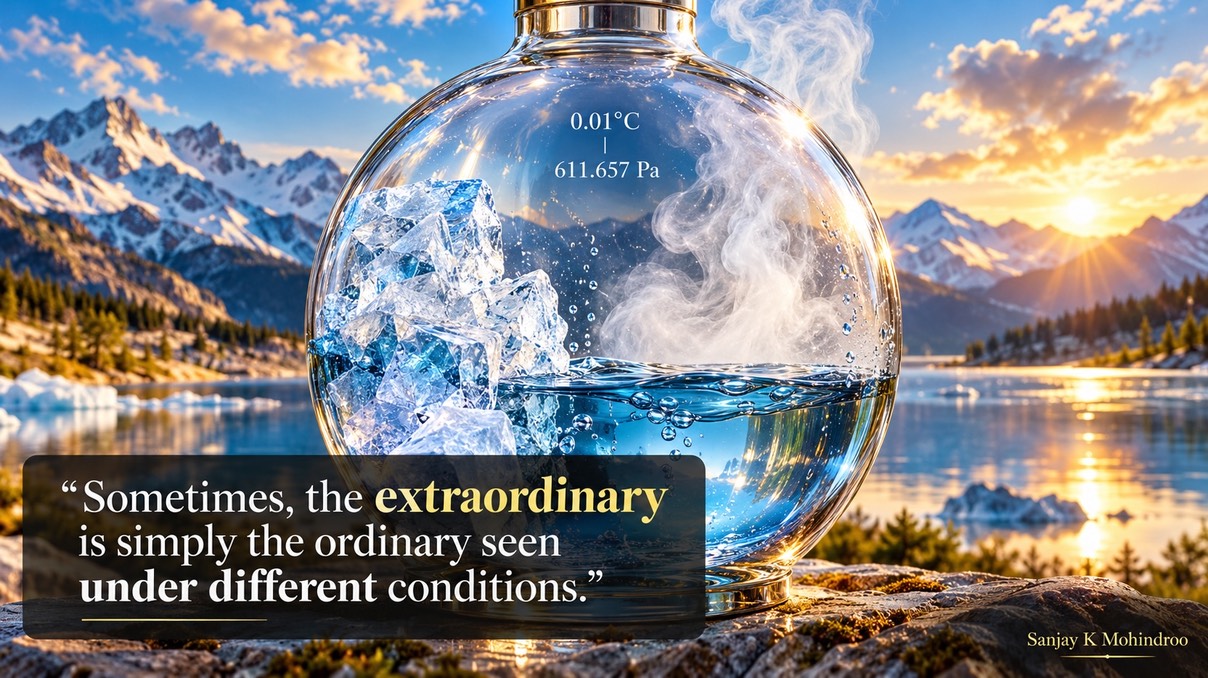
There is a precise combination of temperature and pressure at which ice, liquid water, and water vapor can coexist in equilibrium. Scientists call it the triple point of water.
The phenomenon is more than an unusual laboratory observation. It reveals something profound about matter: temperature alone does not determine its physical state.
Pressure has an equally important role to play.
And once we appreciate that relationship, familiar water begins to look surprisingly unfamiliar.
The Meeting of Three States
A delicate equilibrium at the boundary between solid, liquid, and gas.
Imagine a sealed scientific chamber containing pure water.
The temperature is carefully maintained at 0.01°C, just above water's familiar freezing temperature at ordinary atmospheric pressure.
The pressure is reduced to approximately 611.657 pascals, barely 0.6% of normal sea-level atmospheric pressure.
Under these conditions, something remarkable becomes possible.
Solid ice, liquid water and water vapor can all exist together without one phase inevitably replacing the others.
This is the triple point.
At first, the idea sounds contradictory. We expect ice to melt when heated, water to freeze when cooled and liquid to boil when sufficiently heated.
Yet these changes are not governed by temperature alone.
The pressure surrounding a substance changes the conditions under which it melts, freezes or boils.
At the triple point, the boundaries separating the three states meet.
Molecules continue moving between phases. Some ice molecules enter the liquid. Some liquid molecules join the vapor. Others move in the opposite direction.
At equilibrium, these competing processes balance one another, so the overall amounts of each phase can remain unchanged.
It is not a state of inactivity. It is a state of dynamic balance.
That distinction makes the phenomenon especially beautiful.
The Pressure We Rarely Think About
An invisible influence quietly shaping familiar experiences.
Most of us understand temperature intuitively.
We know that water freezes in a sufficiently cold environment and boils when heated.
Pressure is less obvious because we live surrounded by it.
The atmosphere presses against everything around us, yet we rarely notice its presence.
At sea level, water normally boils at approximately 100°C. Climb a mountain, however, and the boiling temperature falls.
At high altitudes, reduced atmospheric pressure allows water to boil at lower temperatures. This is one reason cooking can take longer in mountain communities.
A pressure cooker demonstrates the opposite relationship.
By maintaining a higher pressure inside the vessel, it raises the boiling temperature of water. Food can then cook at temperatures above those reached by boiling water in an open pot at sea level.
These everyday experiences point towards the same scientific principle.
The physical behavior of water depends on its surrounding conditions.
At the triple point, that principle reaches an extraordinary boundary.
Reduce the pressure sufficiently and liquid water becomes increasingly difficult to maintain. Below the triple-point pressure, stable liquid water cannot exist in equilibrium with its solid and vapor phases.
Instead, ice can transform directly into vapor through sublimation.
The lesson is subtle but powerful: even familiar substances behave differently when their environments change.
A Tiny Point with Enormous Scientific Importance
Precision turns an unusual natural phenomenon into a scientific reference.
The triple point of water is not merely an interesting curiosity.
It has played an important role in the history of temperature measurement.
For decades, scientists used the triple point of water as a fundamental reference for defining the kelvin, the SI unit of thermodynamic temperature.
Its temperature was assigned exactly 273.16 kelvin under the former definition.
That gave researchers a highly reproducible reference for calibrating precision thermometers.
In carefully designed triple-point cells, pure water can be maintained in the three-phase equilibrium needed for temperature calibration.
The result is a stable and reproducible temperature reference that has supported measurements in scientific laboratories and national metrology institutions.
In 2019, the SI definition of the kelvin changed. The unit is now defined by fixing the numerical value of the Boltzmann constant, which connects temperature with energy at the microscopic scale.
The triple point of water remains valuable for practical thermometry, even though it no longer defines the kelvin.
This history illustrates a fascinating relationship between natural phenomena and human progress.
A seemingly obscure property of water helped scientists measure temperature with remarkable consistency.
The same substance that fills our glasses has contributed to the precision underlying modern scientific research.
The Strange Geometry of Possibility
A phase diagram reveals that nature has more than one route between states.
Scientists often represent the behavior of matter using a phase diagram.
It is a map showing the stable physical state of a substance at different temperatures and pressures.
For water, the diagram contains regions corresponding to solid, liquid, and vapor.
The boundaries between these regions indicate conditions at which two phases can coexist.
At the triple point, three boundaries meet.
This creates an unusual intersection, a precise point at which all three phases can remain in equilibrium.
There is another fascinating detail.
Unlike most substances, ordinary ice is less dense than liquid water. This is the reason ice floats.
It also gives the solid-liquid equilibrium boundary of water an unusual slope over familiar pressure ranges.
Increasing pressure near the ordinary melting point can favor liquid water rather than ice.
These properties influence natural environments in ways that extend far beyond the laboratory.
Floating ice insulates the water beneath it, helping aquatic life survive beneath frozen lakes.
Water's behavior also plays a role in the physical processes that shape glaciers and frozen environments.
A single-phase diagram therefore connects molecular behavior with experiences ranging from a glass of ice water to a winter lake.
It reminds us that nature's complexity often emerges from surprisingly simple relationships.
The Quiet Wisdom of Coexistence
Balance can be active, delicate, and unexpectedly productive.
There is something appealing about the triple point beyond its scientific elegance.
We often think in opposites.
Solid or liquid. Stability or change. One condition or another.
But water demonstrates that boundaries are not always as absolute as our everyday experience suggests.
At the triple point, three distinct states coexist because the surrounding conditions allow them to.
This is not a claim that scientific equilibrium and human relationships operate by the same rules. They do not.
Still, the phenomenon offers a useful metaphor.
In organizations, communities and personal decisions, we sometimes assume that different approaches must compete until only one remains.
Yet there are circumstances in which apparently competing qualities can support a productive balance.
Discipline and creativity can coexist. Ambition and patience can reinforce each other. Stability and experimentation can occupy the same organization.
The scientific phenomenon does not prove these human possibilities.
It simply offers a memorable image through which to consider them.
Perhaps that is one of the pleasures of science. It gives us precise explanations of nature while also expanding the language of our imagination.
Beyond the Familiar Boundaries
The greatest surprises often emerge when we reconsider ordinary assumptions.
The triple point of water is easy to overlook because its ingredients are so familiar.
Ice. Water. Vapor.
Nothing exotic is required.
Only an unusual combination of temperature and pressure.
Yet under those conditions, our everyday expectations no longer provide a complete explanation.
Water reminds us that the behavior of something familiar can change dramatically when its environment changes.
That observation belongs to physics, but it also encourages a broader habit of mind.
Before deciding that something is impossible, it may be worth examining the conditions behind that judgment.
The extraordinary is not always hidden in distant places or unfamiliar materials.
Sometimes, it is waiting inside a drop of water.
And sometimes, a different set of conditions reveals possibilities we never thought to imagine.
#Science #Physics #TriplePoint #WaterScience #Thermodynamics #PhysicalScience #StatesOfMatter #ScienceCommunication #ScienceEducation #Curiosity #Nature #ScientificThinking